A note on these reports. This is the fourth written in something close to real time, in the first days of the following month. The figures come from our Open Collective ledger, our Stripe account, Savannah, our updates server and a handful of public sources, and are prepared with the help of Claude. Where a number is a detection or an estimate rather than a measurement, I have made that clear in the description.
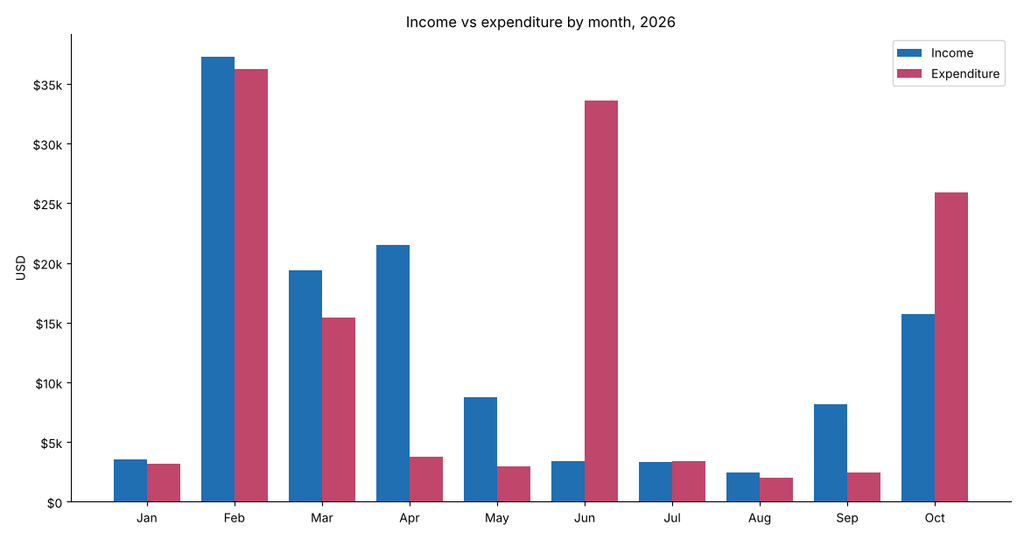
October was the month the summer’s deferred invoices from Open Source Collective started to be paid. Two of the three outstanding payroll invoices from Open Source Collective, for July and August, were settled, a little over $12,000 between them, and that was only possible because Leuchtfeuer paid $12,000 towards next year’s membership renewal early. Add the first big round of conference bills and October shows the largest expenditure of the year outside June.
The money
Income
Income for October was $15,739.69, our strongest month since April. Most of it was one payment, and the rest came from the broad base that has carried us through the autumn.
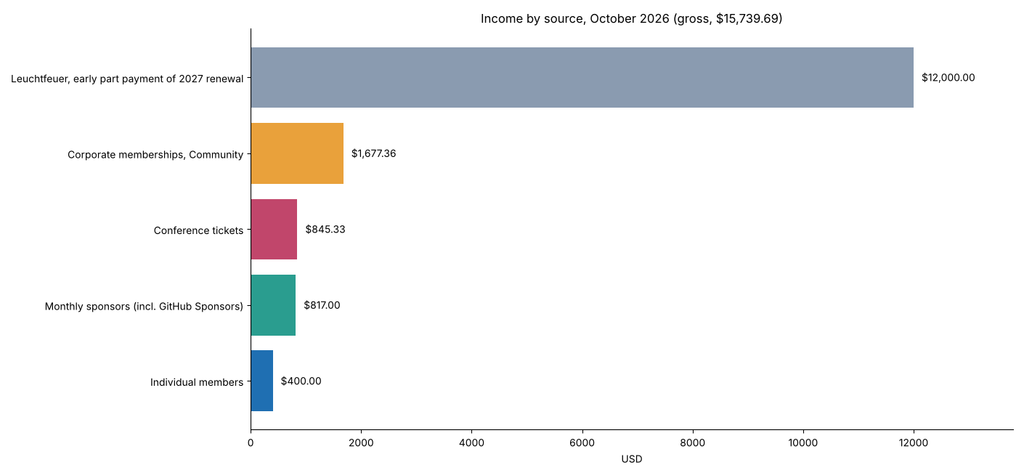
The largest line was $12,000.00 from Leuchtfeuer, a partial payment made early against their 2027 membership renewal, at a point when it made all the difference to our cashflow. We are very grateful to them, and it is worth being clear that this is next year’s income arriving early rather than new money we brought in this month.
Memberships were encouraging in their own right. SignPresenter joined as a new Community corporate member at $1,200.00, and Axelerant renewed at the Community Tier adjusted according to the Big Mac Index (down from Growth tier) membership at $477.36.
Four individual members renewed at $100 each, Joey Keller, Eric Greenberg, Leonardo Schuler and Shawngela Pierce, $400.00 in all.
Our monthly sponsors contributed $787.00 between them, and we welcomed VeilStrat as a new $100 a month sponsor alongside Aivie, Dropsolid, Sales Snap, Ferienhausmiete.de, Hostnet and e-tailors Europe, with GitHub Sponsors adding a further $30.00.
Conference ticket sales brought in $845.33, and are ring-fenced to the conference fund.
| Source | Amount |
|---|---|
| Leuchtfeuer, early part payment of 2027 renewal | $12,000.00 |
| Corporate memberships, Community | $1,677.36 |
| Conference tickets (net of one refund) | $845.33 |
| Monthly sponsors (incl. GitHub Sponsors) | $817.00 |
| Individual members | $400.00 |
| Total | $15,739.69 |
Expenditure
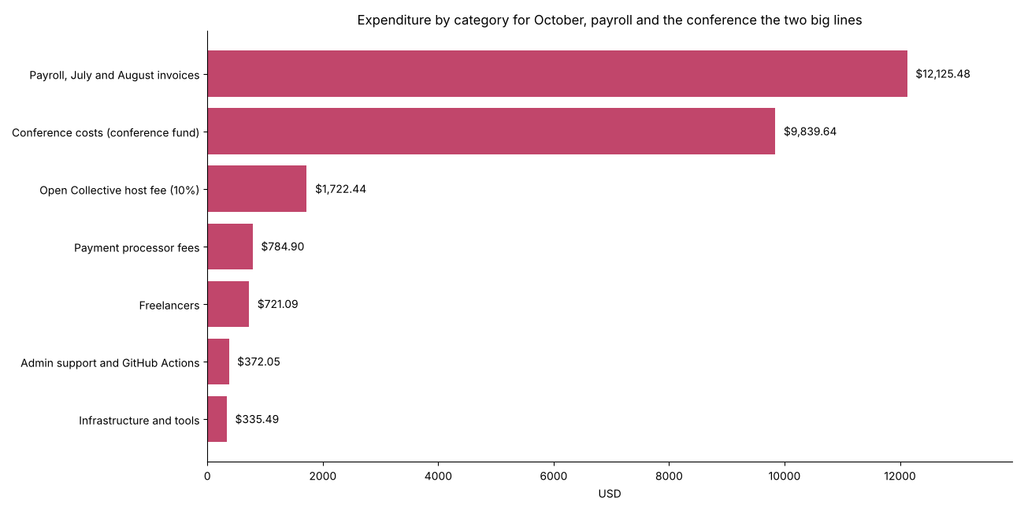
Spending was $25,901.09, and two things account for almost all of it.
The first is payroll. The invoices from Open Source Collective covering employment costs for July ($5,973.45) and August ($6,152.03) were paid on 8 and 22 October, $12,125.48 in total. These had been deferred since the summer until we had cleared funds to cover them. We were given a deadline to make payment from Open Source Collective, so the Council discussed how to achieve this in the latest meeting.
September ($6,177.85) and October ($6,074.44) remain outstanding, a further $12,252.29, so we are not out of the woods, but we have gone from three months owing to two and we have expected income this month and next to allow us to clear these remaining invoices, after which the amount drops substantially following the reduction in hours to half a day a week which takes around a month to be represented in the invoices.
The second is the Mautic World Conference, which takes place in London on 4 and 5 November. The conference fund paid $9,839.64 in October, almost all of it the catering and facilities bill of $8,590.56, plus T-shirts ($883.01), lanyards ($243.88) and the trophies for the Mautic Awards ($122.19). These costs are covered by the sponsorship and ticket income we have been collecting into that fund since the spring.
The ordinary running costs were modest by comparison. The Open Collective host fee was $1,722.44, most of it the 10% charged when $15,807.36 of Stripe takings were swept across to our collective during the month.
Payment processing fees across Stripe, PayPal and Wise came to $784.90, of which $632.29 was the Stripe fee on the month’s card payments.
Our freelance marketing support was $721.09, one combined reimbursement for GitHub Actions and September’s admin support was $372.05, and infrastructure and tooling came to $335.49, the usual Infomaniak, Supabase, Savannah, Mailfloss, n8n and HubSpot subscriptions plus two domain renewals.
A $300 Discourse charge was erroneously taken and refunded within the month, so it nets to nothing, though Open Collective still charged $30 on the refund.
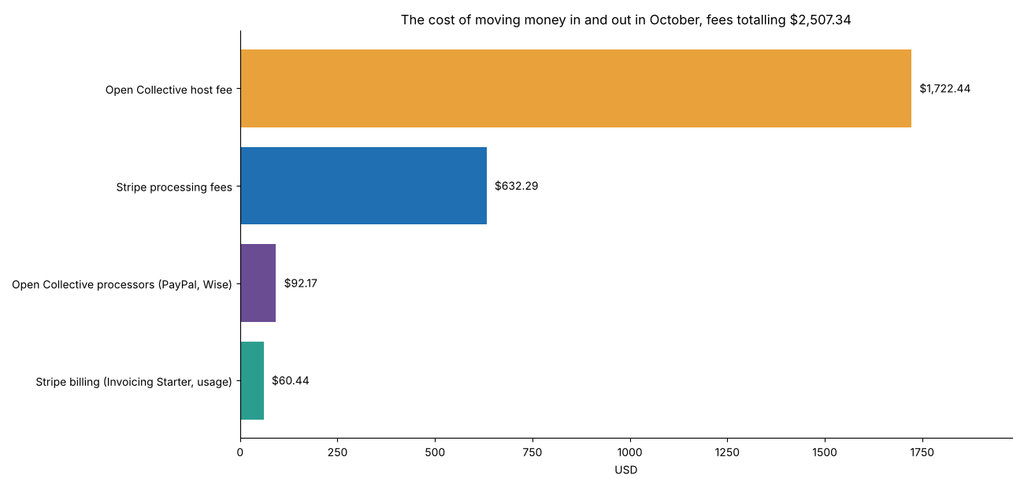
The full cost of moving money in and out came to $2,507.34, which is a lot higher than usual for the simple reason that $15,807.36 of Stripe takings were swept across to our collective during the month, and Open Collective charges its 10% host fee on every dollar that arrives. Stripe’s own processing fees were $632.29, most of it on the Leuchtfeuer payment, and Stripe also charged $48 for its invoicing product, which we use for membership and sponsorship invoices. Taken together the fees are around 16% of everything that came in during October, lifted well above the usual level by the size of the income.
Where we stand
The reconciled net for October was a deficit of $10,161.40, which ties exactly to the movement across our accounts, Open Collective down $8,284.00 and Stripe down $1,877.40 as the balance there was swept across. Total cash across every account closed at $14,674.86 on Open Collective, with $20.06 left in Stripe.
The unrestricted operating balance in the main collective rose from $4,261.30 to $5,451.93, even after paying two months of wages, because the Leuchtfeuer payment landed in October and because we moved the dormant Marketplace Initiative balance of $549.25 back into general funds since this project has now been completed.
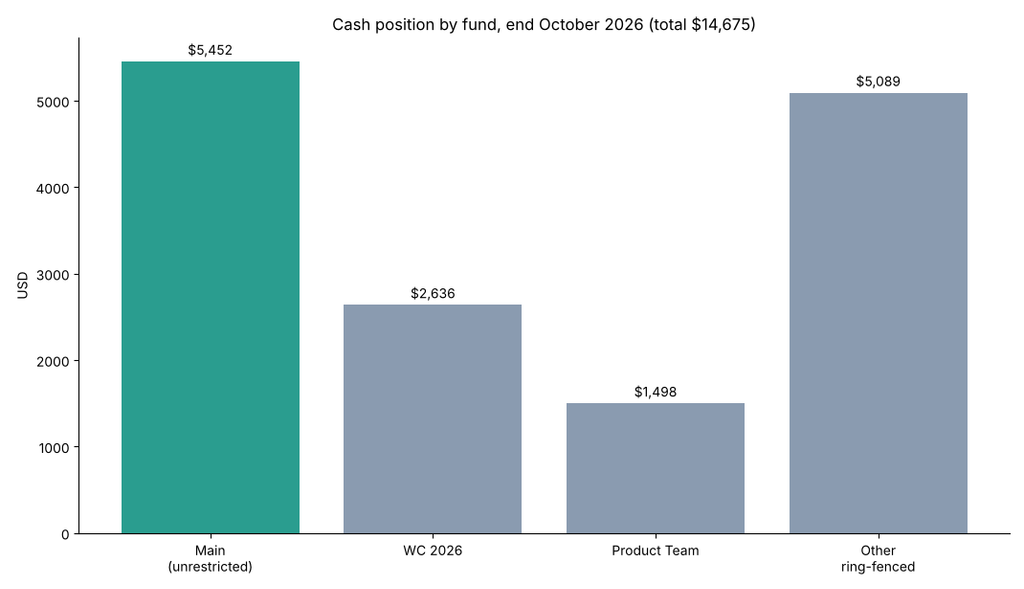
The conference fund fell from $10,840.17 to $2,636.28 as the London bills were paid, the product team fund holds $1,497.67 (which is ring-fenced for our infrastructure costs), and the remaining team and initiative funds total $5,088.98.
Set the $5,451.93 we can actually spend against the $12,252.29 of payroll still owing and the position is plain. We are better than we were, but we are still coming up short.
Our community
Contributions are never only code. Documentation, translation, review, triage, support and the running of events are all part of it, and October had a particular flavour of its own, with the conference team in the final weeks of preparation and a noticeable return of activity from Dropsolid.
New members and contributors
39 people joined the community in October, down from September’s unusually strong 51, a 23.53% fall that still leaves October ahead of every other month this autumn. We welcomed 16 new contributors, two fewer than September’s 18, among them Mahmudur Labib from weDevs and Manuel Camargo from Gopherium. 51 people made at least one contribution during the month, a shade down on September’s 55, while Savannah’s broader measure of active members, which counts conversations as well as contributions, was up 3.33%.
Organisations represented among October’s contributors
| Organisation | Contributors active in October |
|---|---|
| Leuchtfeuer Digital Marketing | 8 |
| Acquia | 4 |
| Aivie | 2 |
| Webmecanik | 2 |
| acolono GmbH | 1 |
| Bloomidea | 1 |
| Casfer | 1 |
| coolabnet | 1 |
| GiadaWare | 1 |
| Gopherium | 1 |
| Linkness | 1 |
| meritoo | 1 |
| moorwald | sven döring | 1 |
| Other Media | 1 |
| rectorphp | 1 |
| Sales Snap | 1 |
| UpScale | 1 |
| weDevsOfficial | 1 |
| Total | 30 |
The other 21 contributors active in October are independent, with no organisation listed against them, which is a healthy share, and a reminder that our community is not only made of agencies. Eighteen organisations were represented, the broadest spread of the autumn.
Most active organisations
By conversation activity in Savannah, the organisations driving the most activity this month were:
- rectorphp (272, ⬇️ 34.46%)
- Acquia (126, ⬇️ 12.50%)
- Leuchtfeuer Digital Marketing (109, ⬆️ 15.96%)
- moorwald | Sven Döring (70, ⬆️ 150%)
- Sales Snap (68, ⬆️ 83.78%)
- UpScale (44, ⬇️ 59.26%)
- Webmecanik (23, ✨ New entry)
- GiadaWare (21, ✨ New entry)
- PrimeNode (12, ✨ New entry)
- Marblear (10, ✨ New entry)
As ever, the rectorphp name is Tomas Votruba, who uses his own Rector tool to cut away technical debt in the codebase, so it reads as an organisation in the data but is one person’s sustained effort.
Top contributing organisations
By volume of merged and accepted contributions:
- Acquia (228, ⬇️ 9.52%)
- rectorphp (191, ⬇️ 23.60%)
- UpScale (116, ⬇️ 14.71%)
- Leuchtfeuer Digital Marketing (73, ⬇️ 9.88%)
- Sales Snap (43, ⬆️ 95.45%)
- Bloomidea (24, ✨ New entry)
- GiadaWare (24, ⬆️ 500%)
- Aivie (18, ⬇️ 55%)
- meritoo (6, ✨ New entry)
- moorwald | Sven Döring (5, ⬆️ 400%)
Most active individual contributors
Setting aside automated accounts and project staff, the most active individuals were:
- Tomas Votruba (272)
- Anderson José Eccel (174)
- Ayu Adiati (146)
- John Linhart (114)
- Sven Döring (70)
- Predrag Vukovic (68)
- Alexander Zlobin (68)
- Ekke Guembel (50)
- Margareth Egbuchulam (44)
- Patryk Gruszka (44)
- Martin Vooremäe (44)
Top individual contributors
By accepted contributions:
- Ayu Adiati (333)
- John Linhart (195)
- Tomas Votruba (191)
- Predrag Vukovic (122)
- Martin Vooremäe (116)
- Anderson José Eccel (107)
- Patryk Gruszka (43)
- Alexander Zlobin (43)
- Giancarlo Cicellyn Comneno (24)
- José Fernandes (24)
Ayu Adiati’s 333 contributions in a single month is a remarkable figure, and much of it is the careful documentation and review work that rarely gets the headline. Thank you, Ayu.
Adoption and usage
Trial signups
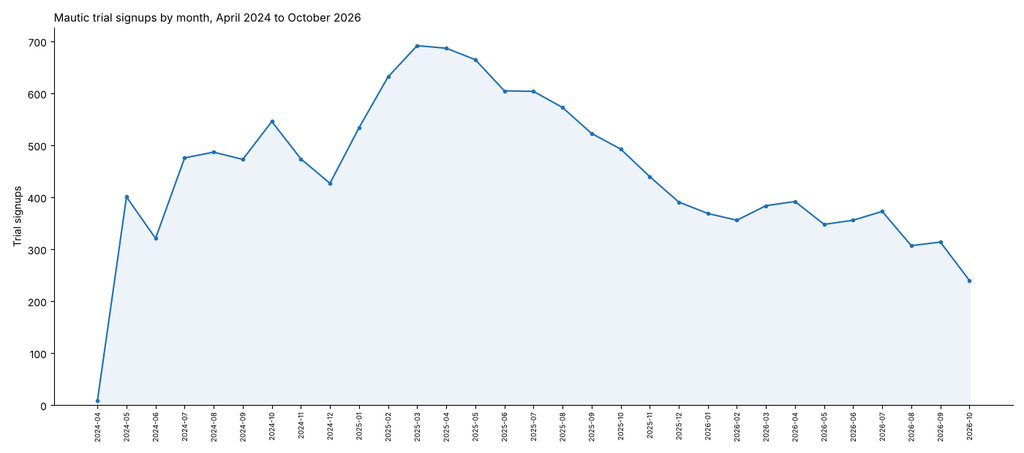
We recorded 240 trial signups in October, the lowest month of the year by some distance after nine months in the 300s, and worth watching. This is likely explained by the fact that we took the signup form offline while the PHPShell vulnerability was being patched across the infrastructure. We will look at the trial funnel properly once the conference is behind us, with a new nurturing campaign due to launch soon, and report back in November.
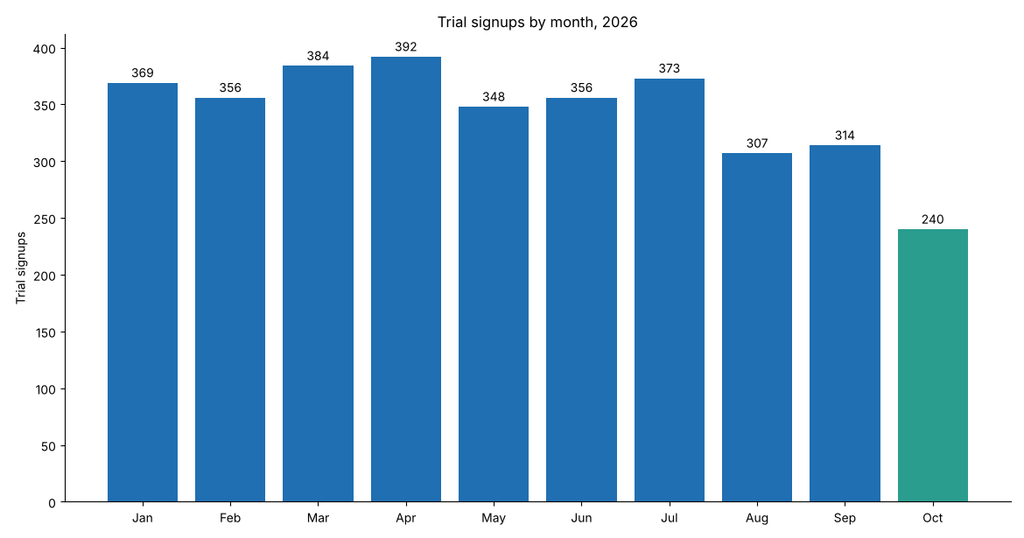
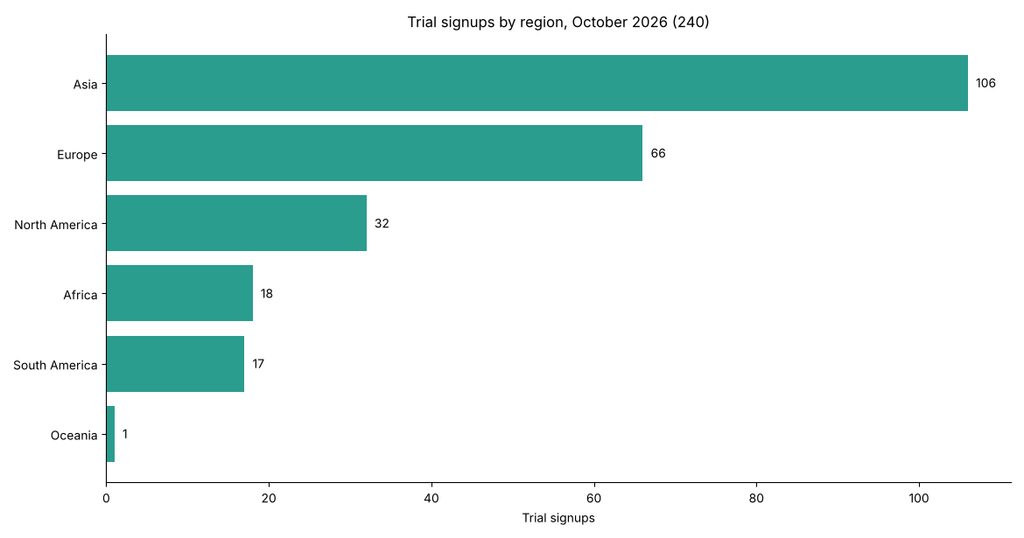
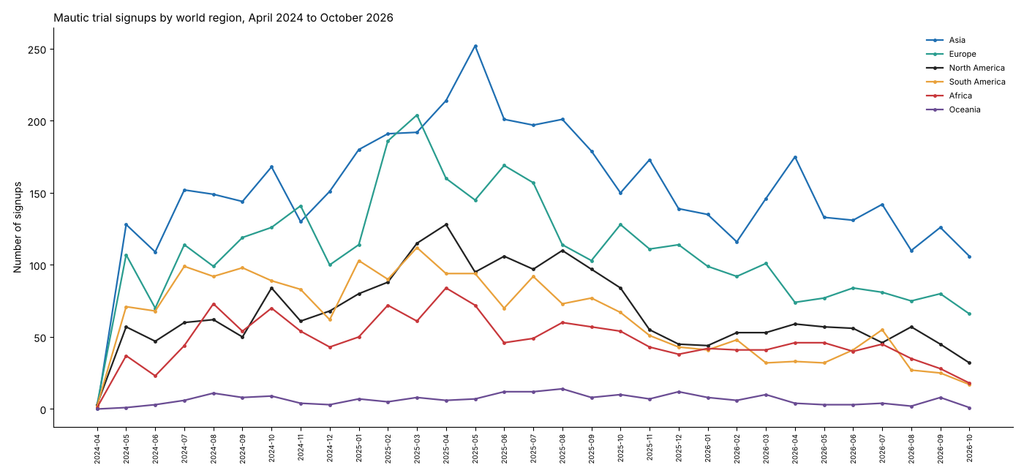
Interest remains strongly international. By region, Asia led with 106, then Europe with 66 and North America with 32, followed by Africa (18), South America (17) and Oceania (1), across 57 countries in all. India (64), the United States (24), Brazil (15), France (13) and the United Kingdom (10) were the top countries. Since the trial opened in April 2024 the form has recorded a little over 14,000 signups.
Taken over the longer span, the picture is of a slow decline from the peak of early 2025, a flat spell between February and September this year, and then October’s step down. The form has recorded a little over 14,000 signups since the trial opened in April 2024, from 192 countries.
Versions and environments
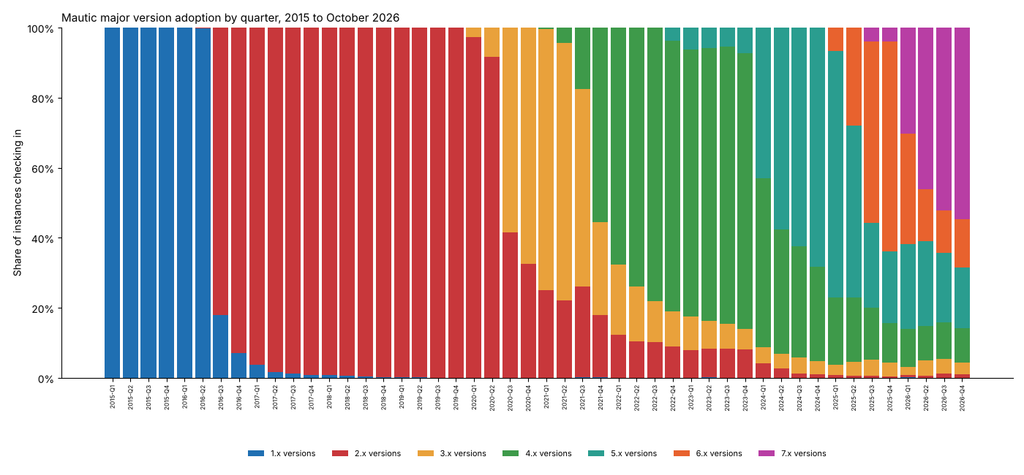
Our updates server recorded 10,123 instances checking in during October, a big step up from the 6,881 we reported for September and the highest monthly figure since we started reporting it. These counts are a last-check-in measure, so the most recent month always looks fullest and earlier months thin out as instances re-check-in later (September now reads 4,586 in this export), which means they are best read as a floor rather than a precise census. The October figure also includes a good number of older installs checking in for the first time in a while, which shows in the version split.
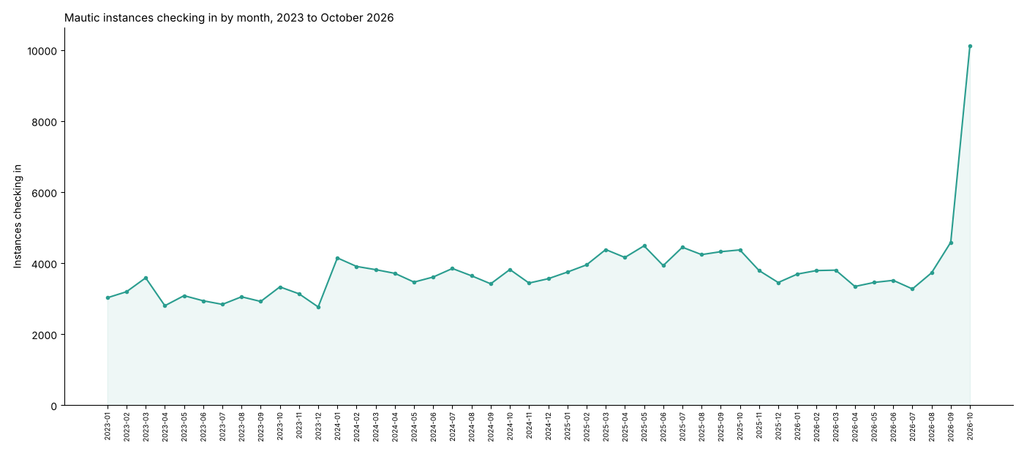
We believe that this is probably related to the PHPShell vulnerability, where servers had to be updated to address the vulnerable PHP versions and most likely, Mautic was updated at the same time. Mautic also released a security release for all supported versions (4, 5, 6 and 7) later that week which probably contributed to this large increase.
Mautic 7 remains the most common version at 54.8% of checking-in instances, with 7.2 alone at 37.8%, followed by Mautic 5 at 17.4%, Mautic 6 at 13.8% and Mautic 4 at 9.6%, and about 4% still on Mautic 3 or older.
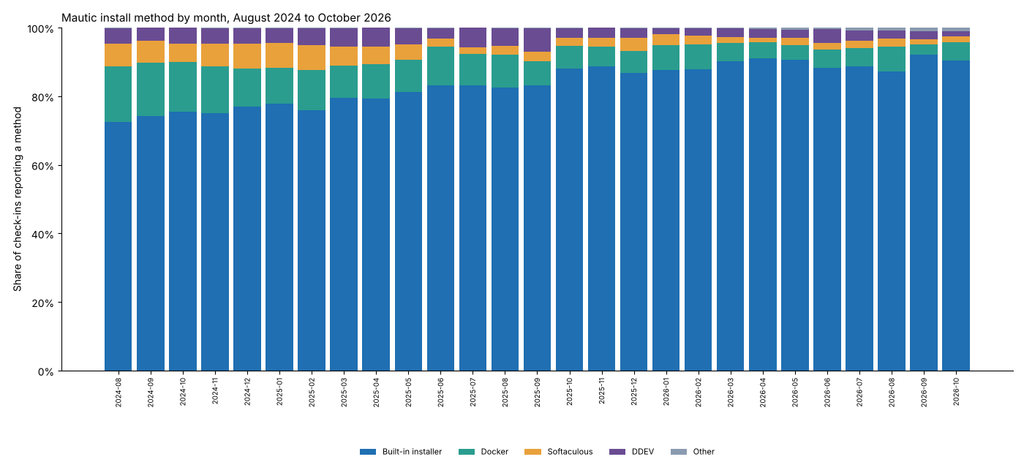
The great majority of installs, 90.5%, use our regular installation, with Docker at 5.2%, Softaculous at 1.7% and DDEV at 1.5%.
On PHP, 49.7% run 8.3, a further 36% are on 8.1, 8.2, 8.4 or 8.5, and about 11% remain on 7.4 or older (hopefully patched against the recent vulnerabilities!), almost all of them the older Mautic versions. Almost everything, 99.0%, runs on Linux.
The wider footprint
BuiltWith detected 30,729 live Mautic sites at the start of November, with a further 129,444 recorded as expired, of which 2,097 sit in the top one million sites and 32 in the top ten thousand. This is detection data, so it captures sites whose Mautic can be fingerprinted rather than every installation, and a site can drop out for ordinary reasons such as blocking bots or a maintenance window.
On GitHub, OSS Insight reports the mautic/mautic repository at 10,795 stars and 3,501 forks as at 1 November, up from 10,632 and 3,481 a month ago.
Looking ahead
By the time you read this the Mautic World Conference will be about to kick off in London, and the November report will carry the full cost and the full story.
The headline for October is that the project has begun to repay what it owes thanks to the support of its corporate members. Two months of deferred invoices have been paid, two remain, and the operating balance is a little healthier than a month ago. What made the difference was one member paying part of next year’s renewal early, which is also the lesson, because that money is borrowed from 2027.
Recurring income, memberships above all, is what turns a month like this from a relief into a plan.
If you would like to help with that, individual and corporate membership are the most direct ways.
I would love to hear what you make of these reports, and what you would like to see in them. You can always reach me through the community channels.