
Note: February->June reports are being back-dated, written in July 2026, as I have been out on sabbatical. I’m experimenting with using Claude (thanks to their 6 months free gift to open source maintainers!) to help automate some of the (very time consuming) parts of creating these reports but they are still reviewed by human eyes before publishing. If you spot anything unusual, please do let us know.
I have been thinking about what resilience actually looks like when you can see every number. Last month I wrote that the real test of an open source project is not how it performs when money is plentiful, but how it holds together when things are tight. February gave us the other side of that same lesson. This was the month our community answered, and it was also the month several deferred costs finally caught up with us. Watching both of those things happen at once, in full view, is exactly why we publish these reports.
Key points
February was an extraordinary month financially, and not in a quiet way. Our community fundraiser brought in more than thirty thousand dollars, the largest single month of income we have recorded in a long time. At the same time, three months of employment costs that had been deferred from October, November and December were able to be paid off, and we also had higher than expected host fees that naturally follow a large inflow of funds. The result was a month that came out very close to balanced, in fact just on the right side of it, carried almost entirely by the generosity of people who believe in what we are building.
Away from the finances, our contributor numbers told an encouraging story. New contributors more than doubled compared with January, new community members grew by around a third, and activity across our contributing organisations was noticeably stronger. Trial signups held steady at around the level we have come to expect, and adoption of Mautic 7.0 continued to spread through our user base.
Finances
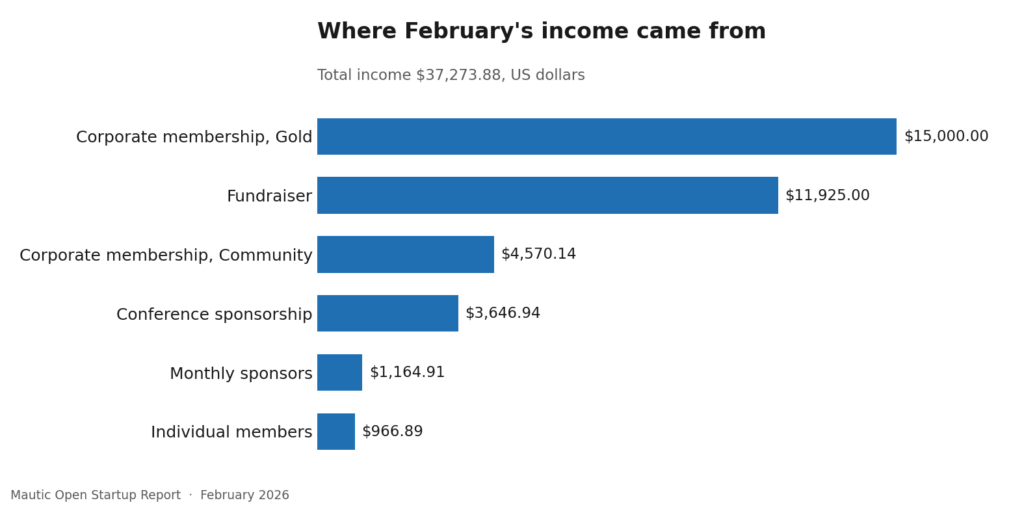
I want to be transparent about how unusual this month looks, because the headline numbers could be read two ways. Our income for February was $37,273.88, drawn from Open Collective and Stripe combined, and our expenditure was $36,258.40, leaving a slim surplus of $1,015.48. On the surface the spending looks heavy. In reality it was a month where an exceptional act of community support met an exceptional, and largely one time, set of costs, and the two very nearly cancelled each other out. In the spirit of these reports I have itemised the income in full and stated it at the point each contribution was charged, so a little under $2,600 of it reached the collective in early March rather than by month end, which is ordinary timing rather than anything to read into.
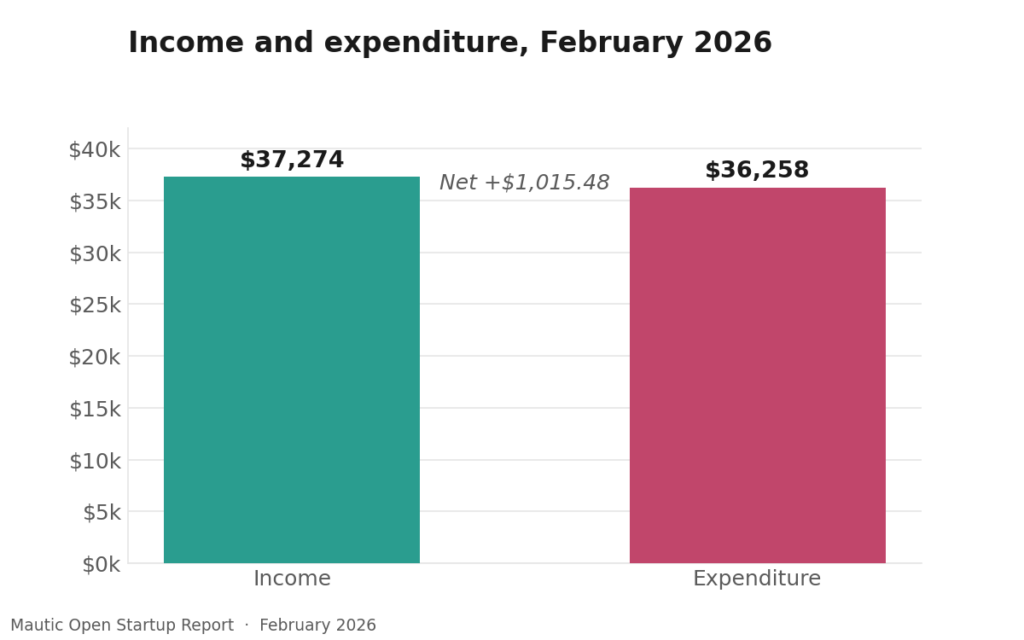
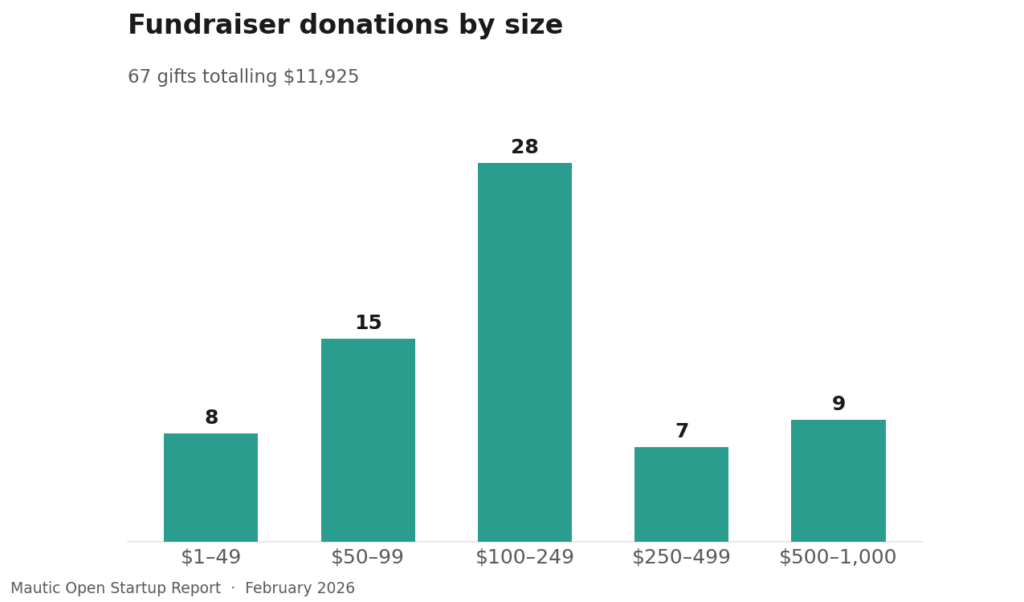
The story sits in the fundraiser. Across February it brought in $11,925 from 67 separate gifts, and it did not stand alone, because our corporate memberships, individual memberships and a conference sponsorship carried the rest of the month between them. This is the community stepping in, in a way that speaks directly to the point I made last month about not wanting to depend on a handful of large sponsors. So many individual contributions built that total, and I am moved by every one of them.
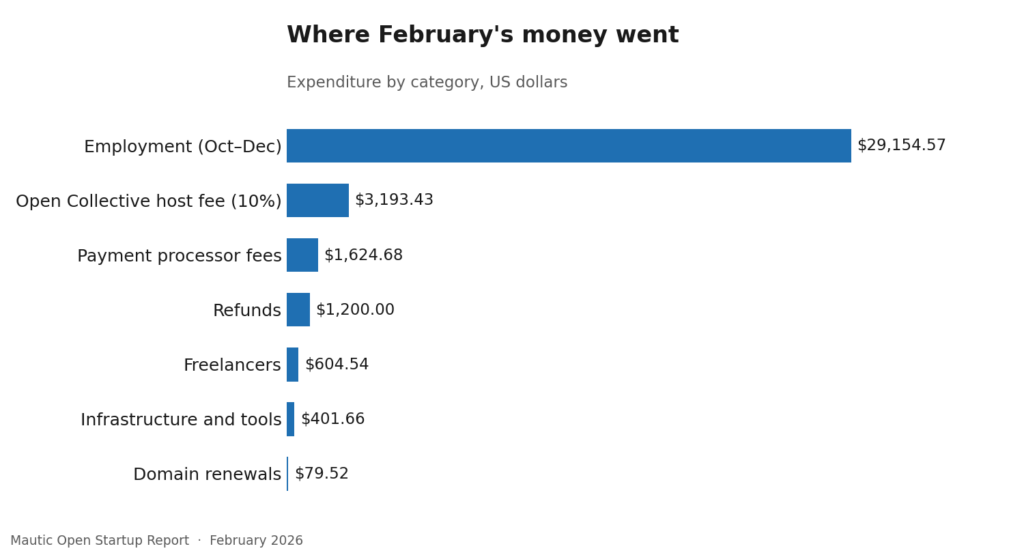
On the expenditure side, the dominant figure is employment. Reimbursements for October, November and December had been held back because we first needed to raise the money to cover them, after a number of memberships were cancelled or reduced and left us short. February is the month we were finally able to settle all three, totalling $29,154.57. That is three months of cost landing in a single line, which is why the figure looks so large against a normal month, and it is the clearest reason the fundraiser mattered as much as it did.
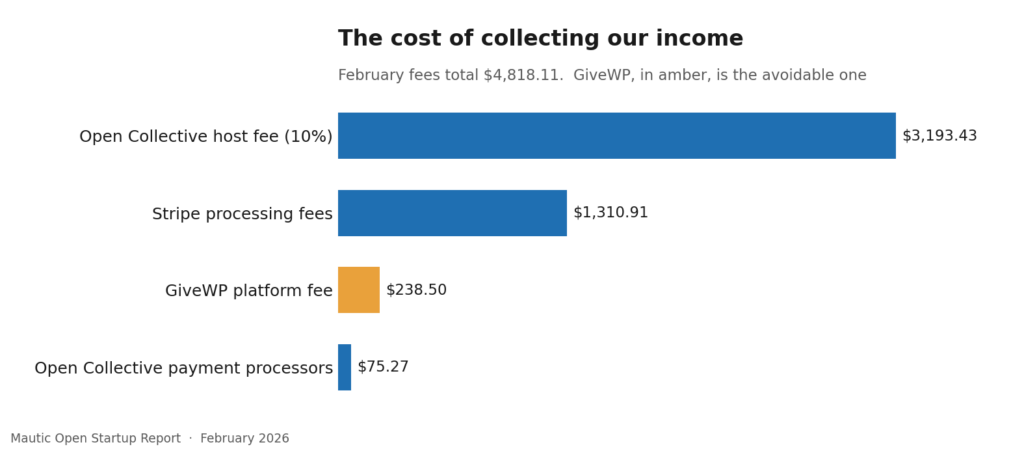
This month I have also chosen to show the full cost of collecting our income, rather than letting it sit quietly inside net figures. Between the Open Collective host fee, Stripe, GiveWP and the payment processors, fees came to $4,818.11, with a further $1,200.00 in refunds for a recurring duplicated subscription which needed to be cancelled. Seeing it laid out is sobering, and it sharpens a question our community has discussed before, which is how much of what people give actually reaches the work.
The GiveWP portion is worth dwelling on, because it is the avoidable one. On the free plan GiveWP adds a 2 percent platform fee to every donation processed through Stripe, on top of Stripe’s own fees. A paid plan removes that, starting at $149 a year, and at $349 a year we could bring all of our membership renewals through GiveWP as well, which would give our members and donors a more streamlined experience. On this month’s giving alone, the $238.50 we paid GiveWP in fees would already have more than covered the $149 licence that removes it, so this is a conversation I want us to keep having. If you have suggestions along these lines, please do let me know.
Income for February
| Source | Amount |
|---|---|
| Fundraiser | $11,925.00 |
| Corporate membership, Gold | $15,000.00 |
| Corporate membership, Community | $4,570.14 |
| Sponsorship (Mautic World Conference, Platinum) | $3,646.94 |
| Individual members | $966.89 |
| Monthly sponsors | $1,164.91 |
| Total | $37,273.88 |
Corporate memberships are shown at their tier, the single Gold membership and four at the Community tier, one of which is priced for its region. Individual members combines the Stripe memberships with those given directly through Open Collective, and monthly sponsors combines our recurring Open Collective sponsors with GitHub Sponsors. That monthly sponsors figure is higher than usual because GitHub corrected a payout error that had affected July and September 2025, allocating the missing amounts to us in February (Open Source Collective, 2026b).
Expenditure for February
| Category | Amount |
|---|---|
| Employment (October, November and December) | $29,154.57 |
| Open Collective host fee (10% of income) | $3,193.43 |
| Payment processor fees | $1,624.68 |
| Refunds | $1,200.00 |
| Freelancers | $604.54 |
| Infrastructure and tools | $401.66 |
| Domain renewals | $79.52 |
| Total | $36,258.40 |
The payment processor fees roll up three sources: Stripe at $1,310.91, GiveWP at $238.50, and the PayPal and Stripe fees on contributions made directly through Open Collective at $75.27.
What I take from this is real encouragement. When we asked, our community responded at a scale that more than covered a month carrying three months of costs, and it did so even after every fee is accounted for. That is the base of sustainable support I keep talking about, and in February we saw it take shape.
Contributions
Our contributor community had a strong month, and the numbers reflect a widening of participation rather than more work from the same few people. We welcomed 56 new community members, up 30% on January, and 22 new contributors, an increase of 120%. Active members grew by 27%. Building together means exactly this, more people finding a way in.
Most active organisations
| Organisation | Activity | Change |
|---|---|---|
| Leuchtfeuer Digital Marketing | 101 | ↑ 80.36% |
| Acquia | 98 | ↓ 36.77% |
| UpScale | 72 | new entry |
| Casfer | 56 | ↑ 43.59% |
| Moorwald, Sven Döring | 49 | ↑ 250% |
| Dropsolid | 39 | ↓ 9.30% |
| Torn-Marketing | 21 | ↑ 133.33% |
| Aivie | 19 | ↓ 5% |
| Webmecanik | 18 | ↓ 59.09% |
| Stefan Franz | 12 | new entry |
It is good to see Acquia continuing to lead on contributions while the breadth of active organisations grows around them. The arrival of UpScale near the top of both lists is especially welcome.
Top contributing organisations
| Organisation | Contributions | Change |
|---|---|---|
| Acquia | 47 | ↓ 4.08% |
| UpScale | 27 | new entry |
| Leuchtfeuer Digital Marketing | 20 | ↓ 16.67% |
| Aivie | 15 | new entry |
| Dropsolid | 9 | ↓ 65.38% |
| Bluespace | 8 | new entry |
| Webmecanik | 7 | ↑ 75% |
| meritoo | 4 | ↑ 300% |
| Dog Byte Marketing | 3 | new entry |
| Casfer | 2 | new entry |
Most active individual contributors
| Contributor | Activity |
|---|---|
| John Linhart | 77 |
| Martin Vooremäe | 72 |
| Ekke Guembel | 66 |
| Renato | 56 |
| Sven Döring | 49 |
| Ayu Adiati | 40 |
| Anderson José Eccel | 36 |
| Achilles Poloynis | 27 |
| Patryk Gruszka | 24 |
| Dwayne Taylor | 21 |
Top individual contributors
| Contributor | Contributions |
|---|---|
| John Linhart | 31 |
| Martin Vooremäe | 27 |
| Rahul Shinde | 15 |
| Patryk Gruszka | 14 |
| Predrag Vukovic | 13 |
| Ayu Adiati | 9 |
| Kaviyaa Devi PM | 8 |
| Oluwatobi Owolabi | 8 |
| Miroslav Fedeleš | 8 |
| Zdeno Kuzmany | 7 |
We were delighted to welcome 22 new contributors in February, among them aamsilva, DevFuture, Kamran Khalid, strma, Denis, Olasunkanmi Emmanuel Jesuferanmi, Abdul Talha, Francois Paulin, Vedant Madane, Turan Almammadov, Max Soukhomlinov, ShawTim and dawn2duskpt. If you are one of them, thank you for taking that first step, and I hope it is the first of many.
Our top supporters this month, helping others in the forums and support channels, were strma and Ekke Guembel.
A note on how I read these lists. I have kept the rankings focused on our volunteer community, so automated accounts and staff activity are set aside rather than counted alongside contributors. The intention is to keep the spotlight where it belongs, on the people choosing to give their time.
Usage of Mautic
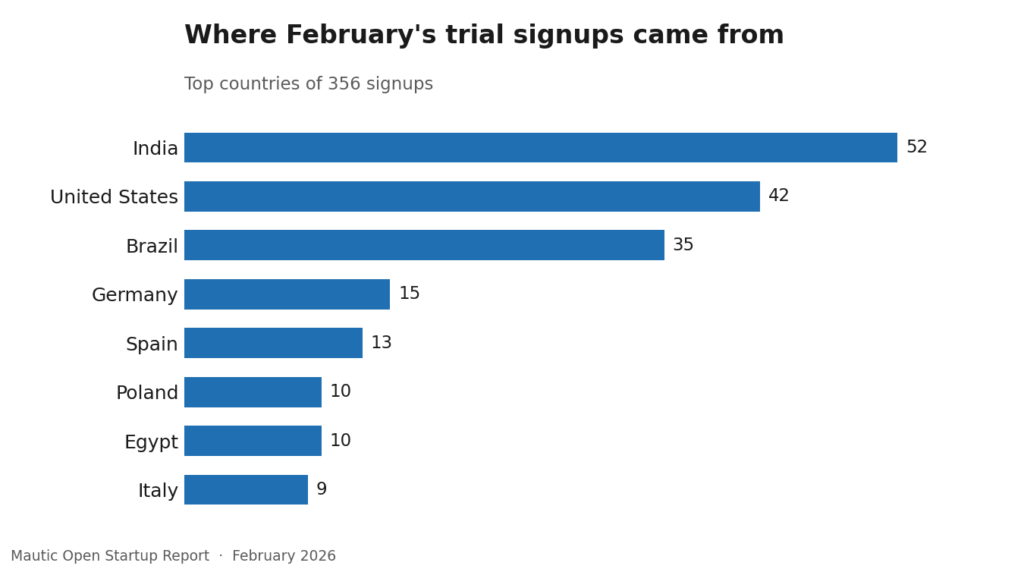
Interest in trying Mautic held steady. We recorded 356 trial signups in February, close to the 369 we saw in January and consistent with the level of around 350 a month that has settled in over recent months. India, the United States and Brazil led the way, followed by Germany and Spain, with Europe, the Americas and the Asia Pacific region all well represented.
What continues to stand out is how many people arrive at Mautic without any marketing automation in place at all. The majority of February signups reported having no current solution, with the remainder coming across from a spread of proprietary tools. For a project whose mission is digital independence, seeing so many people choose an open source path as their first step matters a great deal.
On adoption more broadly, Composer installations of Mautic through Packagist rose to 95 in February from 75 in January, an increase of around 27%. Looking outward, a BuiltWith export taken on 26 March lists 24,508 live Mautic sites, with France and the United States making up the largest share by some distance, and 205 newly detected during February.
I share that BuiltWith figure with an important caveat. It can only see sites that have Mautic’s tracking script switched on, which many installations do not use, and its detection is not always accurate, so it is not a one to one picture of Mautic in the world. It is best read as an indicative signal rather than a true count, and the real number is certainly higher.
A word on version adoption and installation methods. We can pull these from the Mautic updates server, but the figures carry a real limitation, because the server records the date an instance last checked in or updated rather than taking a live census. As this report is being written somewhat late, the data will be inaccurate. What I can say with confidence is that adoption of Mautic 7.0 has continued to spread since its January release, with people updating gradually from older versions.
Community health
The clearest sign of health this month is the doubling of new contributors, because a project stays alive through the people who keep arriving. A 120% increase in new contributors alongside a 30% rise in new members tells me our routes in are working, from first forum post to first merged pull request.
I am also encouraged by the spread of contribution across organisations. When contribution concentrates in one or two companies it creates fragility, and when it widens it creates resilience. February leaned towards the healthier pattern, with more organisations active and several smaller contributors stepping up. That is the kind of quiet, distributed strength that keeps an open source project independent.
Conclusion
If January showed that Mautic has grit, February showed something I value just as much, that our community shows up. Faced with a month of unusual costs, hundreds of people chose to give what they could, and together they very nearly carried the whole load. No single large sponsor did that. We did.
Generosity is not measured by the size of the gift but by the spirit in which it is given. This month I saw a great deal of that spirit, and it leaves me more confident than ever about the base we are building together.
If you would like to be part of that base, becoming a member is the most direct way to help us plan with confidence rather than depend on exceptional months.
I would love to hear what this report brings up for you, so please do come and share your thoughts in the community.
References
BuiltWith – All live Mautic sites, export dated 26 March 2026. Available at: https://trends.builtwith.com/analytics/Mautic
Open Source Collective (2026a) Mautic collective transactions ledger, February 2026. Available at: https://opencollective.com/mautic
Open Source Collective (2026b) January update for OSC. Available at: https://opencollective.com/opensource/updates/january-update-for-osc
Packagist mautic/core-lib download statistics, February 2026. Available at: https://packagist.org/packages/mautic/core-lib
Savannah CRM Mautic monthly community report, February 2026. Available at: https://savannahcrm.com/public/report/1d9bd490-c48e-4a75-b520-2724d906fa6b/
Stripe Mautic payment records, February 2026. Internal account data.
Mautic Trial signup submissions, February 2026. Internal form data.