Note: This is the first report written in something close to real time since I returned from sabbatical, following the back-dated February to June set. I’m experimenting with using Claude (thanks to their 6 months free gift to open source maintainers!) to help automate some of the very time consuming parts of creating these reports, but they are still reviewed by human eyes before publishing. If you spot anything unusual, please do let us know.
Key points
Income for July was $3,310.17 and expenditure was $3,439.82, which leaves a small deficit of $129.65. That is about as close to level as our accounts come.
The month carried two new lines of income that did not exist in our accounts before, the Mautic 6 Developer Certification and a Bronze sponsorship for this year’s Mautic World Conference. It also carried a $1,200 refund of a membership taken in June, which was very nearly offset by a Community tier corporate membership renewing right at the end of the month.
Finances
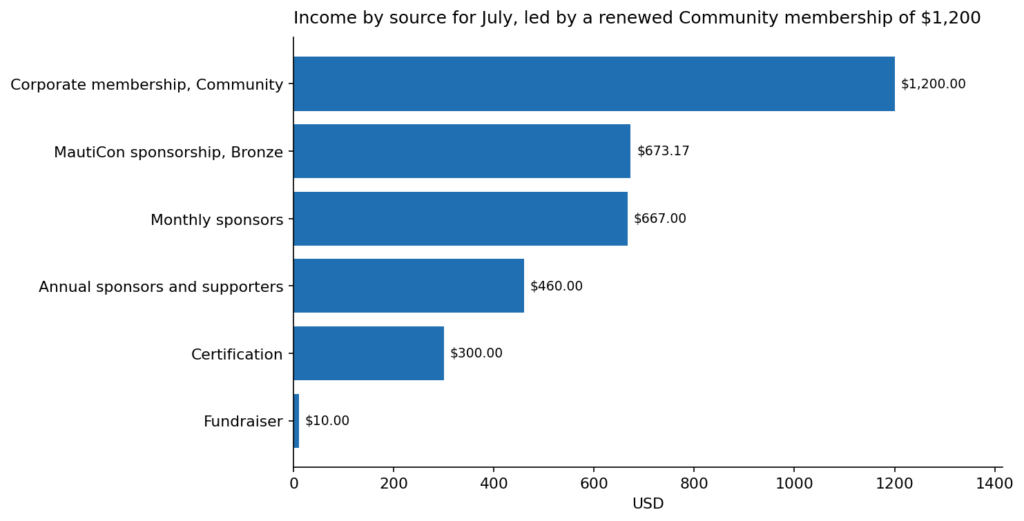
Let me start with the two memberships that pass each other in this month’s figures, because between them they tell the whole story of why July looks so level. In June we recorded a Community tier corporate membership of $1,200 taken through Stripe which was refunded in full on 15 July at the request of the company. They decided they no longer wanted to support Mautic financially, unfortunately. On the basis we use here, income is recognised when it is charged and a refund is carried as a cost in the month it is paid out, so June’s income stands as reported and July carries the reversal. Then, on the last day of the month, FireMultimedia renewed their Community tier corporate membership, also at $1,200. One went out, one came in, and the two almost cancel.
There is no employment line at all this month due to lack of available funds to pay the invoice. All of the outstanding payroll from February to June was settled together in June, as I described in the last report, and July’s wages had not been paid by the end of the month. On a cash basis that means nothing lands here, and it will fall into a later month instead.
Income for July
Source
Amount
Corporate membership, Community
$1,200.00
MautiCon sponsorship, Bronze
$673.17
Monthly sponsors
$667.00
Annual sponsors and supporters
$460.00
Certification
$300.00
Fundraiser
$10.00
Total
$3,310.17
The Community membership is FireMultimedia, renewing through Stripe on 31 July, and I am glad to have them with us for another year. The conference sponsorship is a Bronze tier package for the Mautic World Conference 2026, taken by Bouncer and invoiced in pounds at £500, which settled at $673.17 after currency conversion. It is the first MautiCon sponsorship of this cycle, and it is good to see that account opening.
Certification is the line I have been waiting to write. Two people took the Mautic 6 Developer Certification through Stripe at $150 each. I should be honest about the economics, because the $300 is not money we keep. Most of each certification fee is passed to Axelerant – the partner who delivers and proctors the exam for us – so the share the project retains is modest, and the payment we owe them for July’s certifications falls due in August. It is a small beginning, but it is the first time certification has shown up in our accounts at all, and it is a way of funding the project that grows the skills base at the same time as it grows the balance.
Monthly sponsors combines our recurring Open Collective sponsors, among them Aivie, Dropsolid, Sales Snap, Hostnet, e-tailors Europe and Ferienhausmiete.de, with our GitHub Sponsors payout and a couple of small individual monthly gifts. Annual sponsors and supporters covers six yearly contributions through Open Collective, from Alan Gibson, Patrick Jenkner, Jonas Ludwig, Astral Enterprises, lolcode and Deepesh. The fundraiser line is a single $10 donation, the last trickle of a campaign that has otherwise finished.
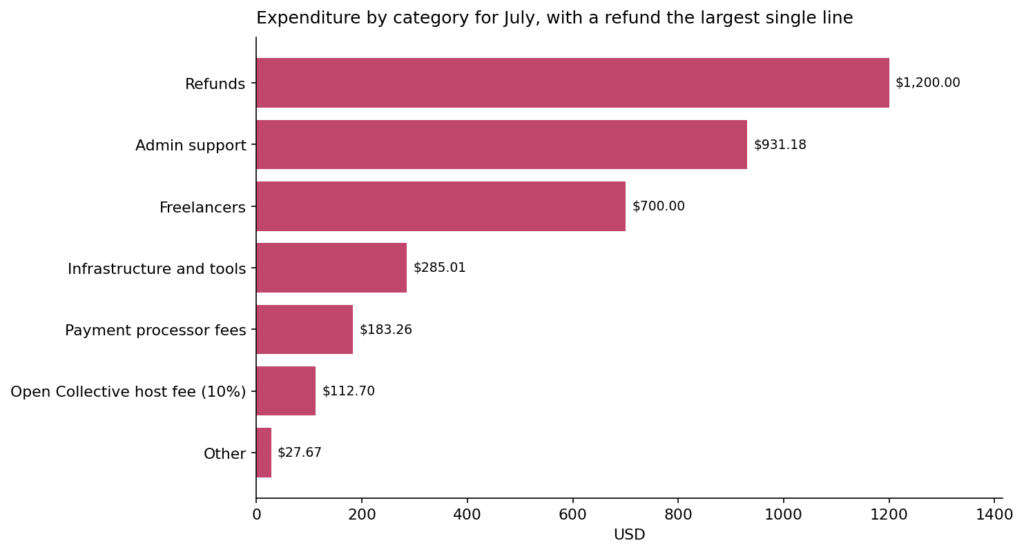
On the spending side, with no employment and no bounties, the month was made up of the refund and the things that keep the lights on.
Expenditure for July
Category
Amount
Refunds
$1,200.00
Admin support
$931.18
Freelancers
$700.00
Infrastructure and tools
$285.01
Payment processor fees
$183.26
Open Collective host fee (10%)
$112.70
Other
$27.67
Total
$3,439.82
Admin support covers two months catching up, May’s admin support at $400.18 and June’s executive assistant hours through Upwork at $531.00. Freelancers is Barsha Devi’s invoice for June. Infrastructure and tools is our usual set, hosting with Infomaniak, Savannah, Mailfloss, n8n, Supabase, HubSpot and GitHub. Other is a contributor data stipend, some minor bank card fees and a small parking cost for an OpenUK event I’m attending in London later in August.
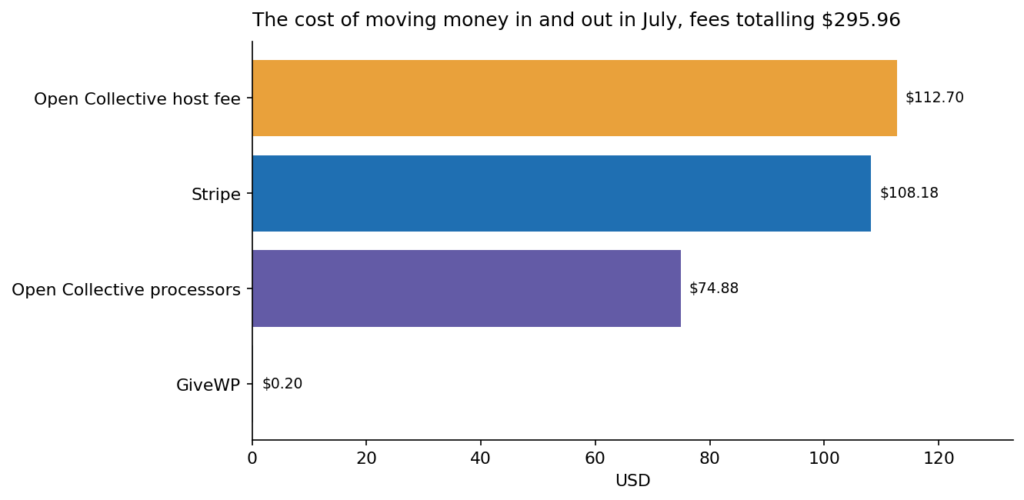
The payment processor fees roll up Stripe at $108.18, Open Collective’s own processors at $74.88, and GiveWP at $0.20 on the single fundraiser donation. Stripe’s fees are higher than usual because a refunded charge still costs us its original processing fee, so we pay twice on money that ultimately came to nothing.
The full cost of moving money in and out came to $295.96, of which the Open Collective host fee at 10% is the largest steady part. That is around 9% of everything given this month, lifted a little by the refunded charge, and it is the price of the transparency and administrative cover we get in return, but it is a number worth keeping in view.
One practical note for anyone reading the accounts closely. No payout was made from Stripe to Open Collective this month because we had to cover the cost of the refund (the funds for the transaction had already left Stripe and landed in our Open Collective), so the FireMultimedia membership and the other Stripe income are still sitting in our Stripe balance rather than in the collective, which is why our Stripe balance ended July at $1,000.89 rather than coming across into Open Collective.
Reading July alongside the months either side of it, the shape of our position is clear enough. Our genuinely recurring income, the sponsors and members who give every single month, came to $667. Another $460 arrived from annual contributions that happened to renew in July, which is real money but not money we can count on next month. Against that, our recurring costs before any wages at all ran to roughly $1,450 in infrastructure, freelance and administrative support. So the monthly base does not yet cover even the running costs, let alone the work, and everything else has to come from memberships, sponsorship, the conference, certification and the trials revenue share, all of which arrive unevenly. Building that base up is the thing I am most focused on now that I am back at my desk, and holding on to the members we already have, as with this renewal on the last day of the month, is just as much a part of that as winning new ones.
Contributions
A note on the figures in this section before I give them. For the back-dated February to June reports I read the community numbers from our Savannah dashboard. This month I have worked from the full Savannah data export instead, which counts on a slightly different basis, so these figures are not directly comparable with the ones printed in earlier reports. I have compared July with June on the same export basis so the direction of travel is sound. Savannah’s live server has also been experiencing some outages while I have been pulling this report, so the community membership figures here are drawn from the export I have to hand and I will revisit them if the refreshed numbers move. One measure I have had to drop this month is the active members figure, due to the server not being able to supply this report without timing out. I will pick it back up when I next have access.
On that basis we welcomed 25 new community members in July, down 28.57% on June’s 35, and 8 new contributors, down 33.33% on June’s 12. Around forty people made a contribution of some kind during the month, once automated accounts and our own staff activity are set aside.
As always, it is worth saying that contributions to Mautic take many forms beyond code. Documentation, translation, design, triage, review, answering questions in the forums and on Slack, and helping run our events are all contribution, and much of the most valuable work our community does never touches a pull request.
Organisations represented among July’s contributors
Organisation
Contributors active in July
Leuchtfeuer Digital Marketing
9
Acquia
5
Aivie
2
Bloomidea
1
Dropsolid
1
Esio.Net
1
Mackenzie
1
meritoo
1
NrohoOrg
1
rectorphp
1
Twentyzen
1
UpScale
1
Webmecanik
1
Total
26
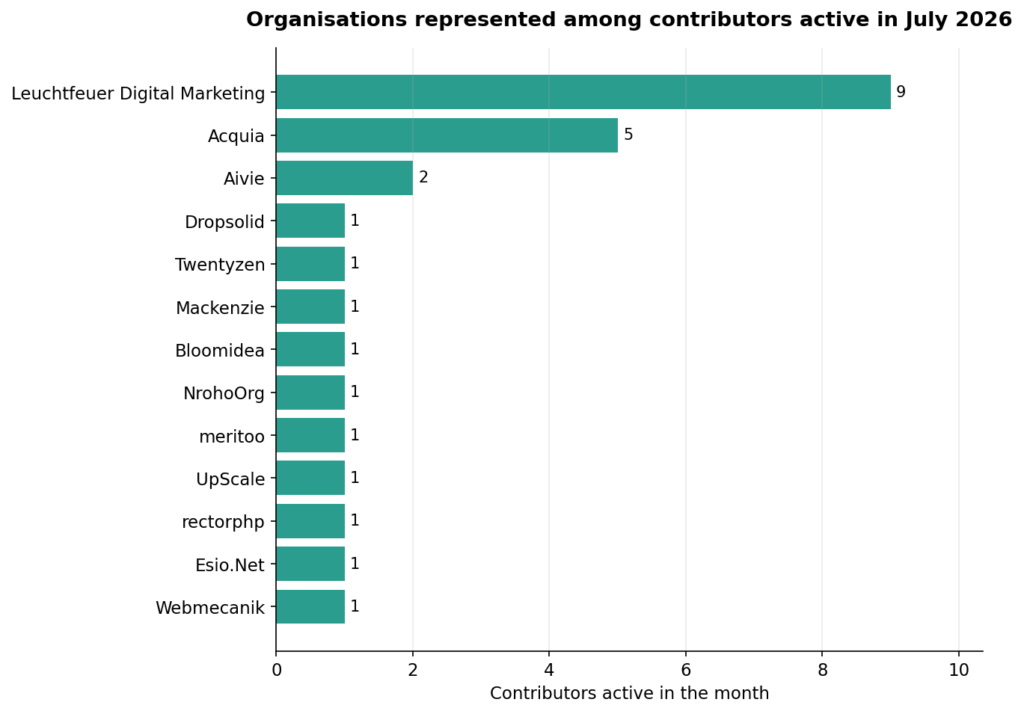
The remaining contributors active in July are independent, with no organisation listed against them, which is a healthy share and a reminder that our community is not only made of agencies.
Leuchtfeuer had nine people contributing in the month and Acquia five, which is a good depth of involvement from both. Tomas Votruba was active again, continuing the modernisation work he began in June. He appears here under rectorphp, after the tool he built for upgrading PHP codebases. He remains a volunteer, and the technical debt he is quietly removing alongside the modernisation work will save us a great deal of pain later.
New contributors in July
Contributor
Organisation
Matthieu Lempereur
Independent
Santhi Prakash
Independent
Israel
Independent
Gustavo Camalionti
Mackenzie
Josh
Independent
Tushar Pagar
Independent
slipknoo822-lang
Independent
peculiaruc
Independent
Eight people made their first contribution to Mautic in July. It is a smaller intake than June, and a smaller one than I would like, but every name on that list is someone who found a way in, and keeping those routes open and obvious is work we should never stop doing.
Usage of Mautic
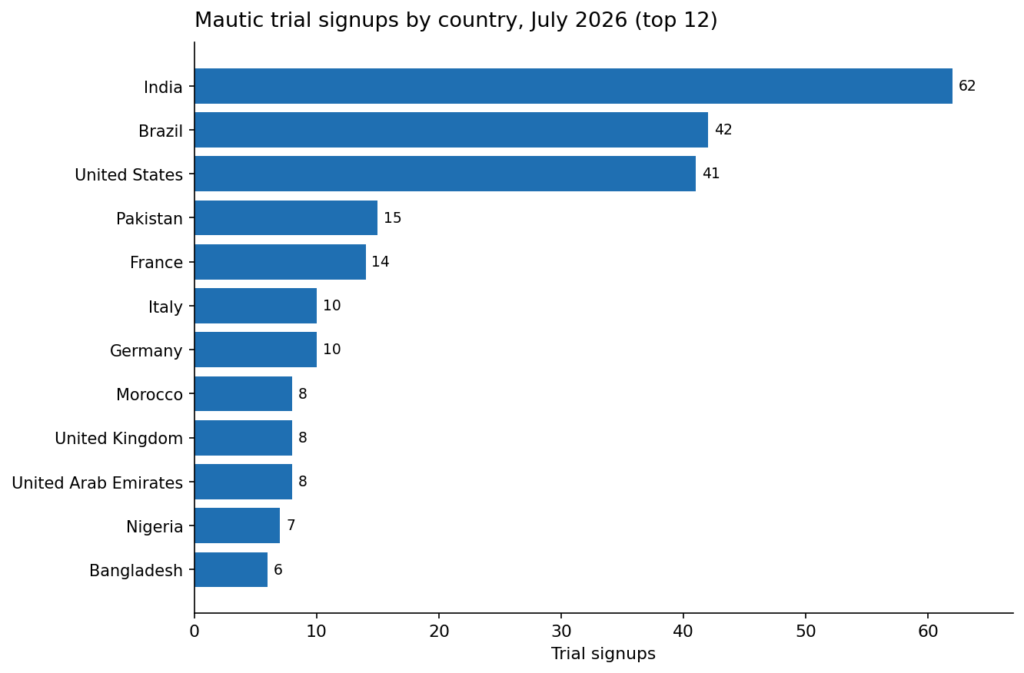
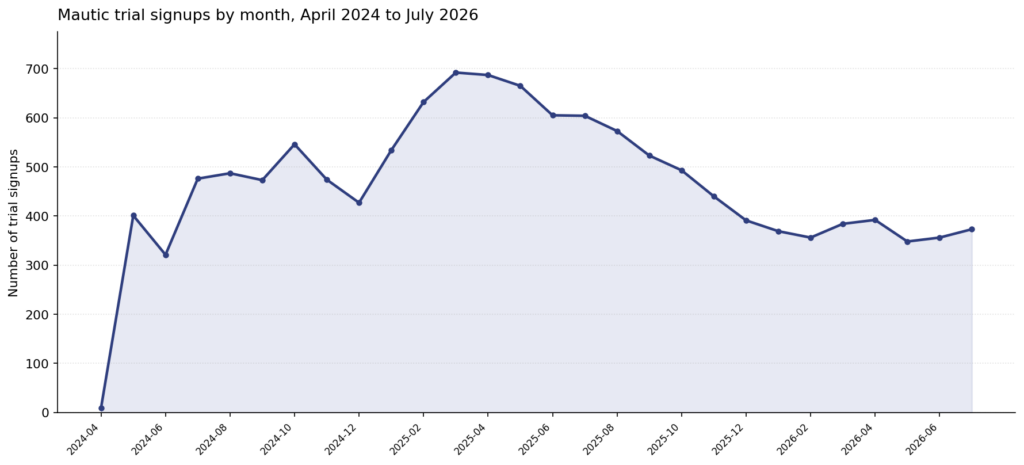
Interest in trying Mautic held steady and edged up a little, with 373 trial signups in July against 356 in June. India led again by a clear margin, followed by Brazil and the United States close together, with Pakistan, France, Italy, Germany, Morocco, the United Kingdom and the United Arab Emirates all featuring. Seventy countries were represented in a single month.
Taken over a longer span, trial signups have now been remarkably flat for six months, sitting between 348 and 392 every month since February. After the decline through the second half of 2025 that stability is welcome, though I would rather see it start climbing again.
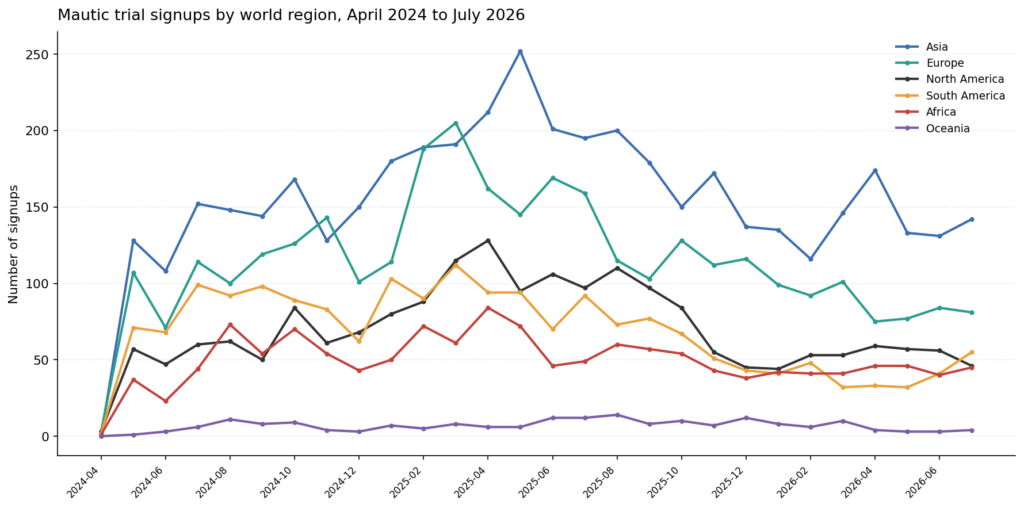
Asia continues to lead, with Europe second and the Americas and Africa steady behind. The breadth of countries reaching for an open source path, 189 across the whole dataset, remains one of the most encouraging signals we have.
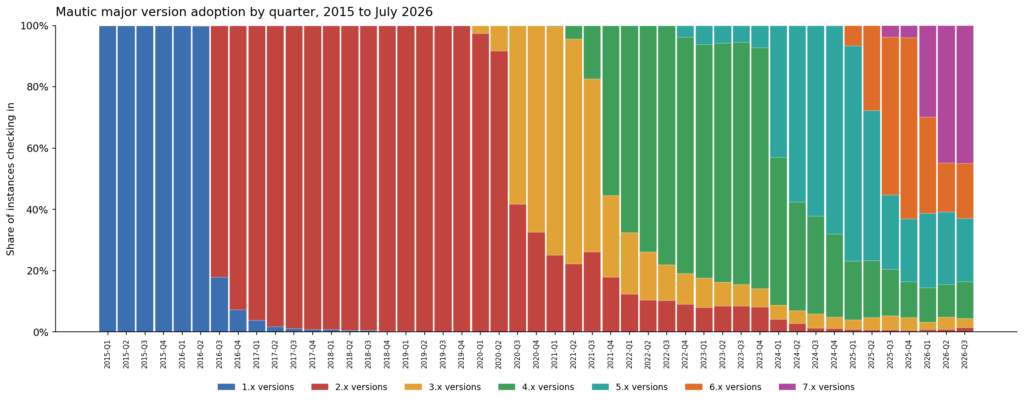
Turning to our updates server, which our instances check in to when they update, the same honest caveat applies as always. It can only see instances that check in and have not disabled the update check, so it undercounts the true population and lags behind reality, and it is best read as a broad signal rather than a census.
On version adoption, Mautic 7 has consolidated its lead. Among instances checking in during July it accounts for around 45%, ahead of Mautic 5 at roughly 21% and Mautic 6 at 18%, with Mautic 4 still on 12%. The share on Mautic 5 has fallen since last quarter while Mautic 6 and 7 have both gained, which is exactly the direction we want.
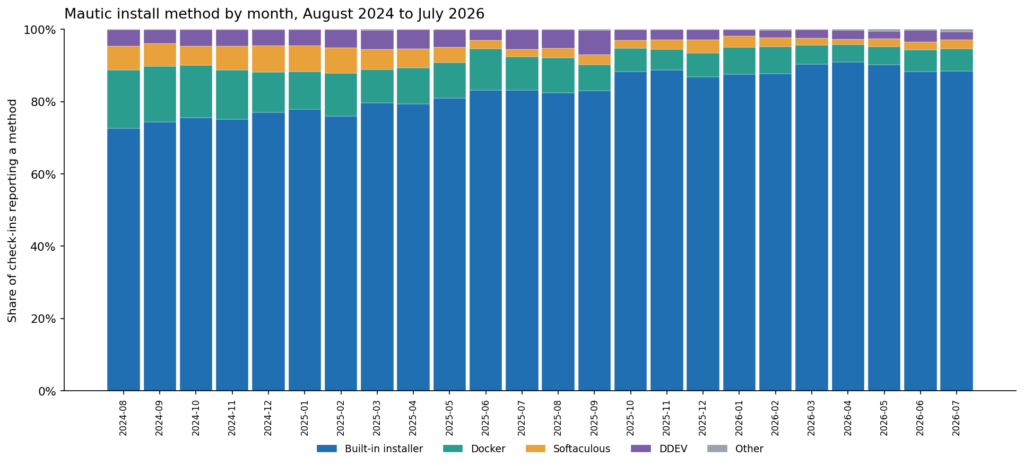
On how Mautic is installed, the built-in installer remains overwhelmingly the most common route at around 88% of check-ins that report a method, followed by Docker at about 6%, then Softaculous and DDEV. The mix has barely moved in two years.
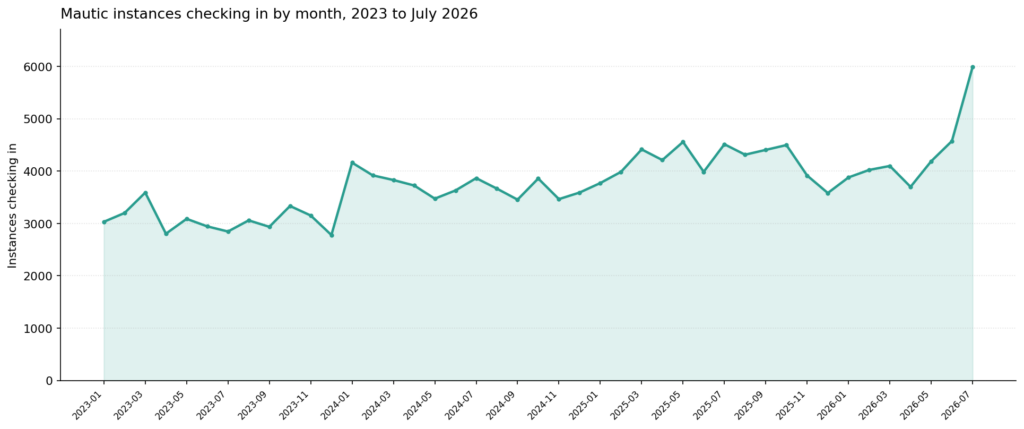
We also saw noticeably more instances checking in during July, 5,992 against 4,575 in June. That is the update check itself, not new installations, so it reflects people applying an update rather than a jump in the population, but it is a good sign that our community keeps its installations current.
On the underlying platform, the great majority of instances run PHP 8, with 8.3 the most common single version at around 48%, though a tail of roughly 13% still runs 7.4 or older, and almost every instance runs on Linux.
This month I am also able to bring back a view I have not been able to share for some time, drawn from our BuiltWith account, which detects Mautic on live websites in the wild. BuiltWith counts 33,241 live sites running Mautic, alongside 124,598 that have used it at some point in the past, with 2,245 of the live sites sitting inside the top million websites globally and 35 inside the top ten thousand. The usual caution applies, since BuiltWith can only see installations that expose a detectable footprint (ie have Mautic tracking on the domain), so this undercounts too, but it is a useful second pair of eyes alongside our own telemetry.
On where those sites are, BuiltWith’s own trends data puts the United States, France and Brazil as our largest markets. Of the countries I counted directly, Germany leads with 1,236 live sites, then Spain on 685, the United Kingdom on 578, Italy on 573, Switzerland on 496 and the Netherlands on 360. Seeing Mautic used at that scale, mostly by people we will never hear from, is a good corrective to reading our health only through the numbers that pass across our own books.
Community health
A quiet month is a reasonable test of underlying health, and July mostly passes it. Fewer people arrived than in June (skewed somewhat by our Community Sprint) and fewer made a first contribution, which I am watching rather than worrying about after a strong June. Around forty people still contributed something during the month across thirteen organisations and a good number of independents, and the installed base is keeping itself current.
Beyond our own figures, the project’s standing on GitHub is steady, with the mautic/mautic repository at over 10,300 stars and 3.4k+ forks – we finally broke the 10k threshold, folks!
Conclusion
What I take from July is that the ordinary month is where the real work of sustainability shows itself. There was no crisis and no windfall, just a refund to absorb, one membership refunded and another renewed, a set of regular costs to meet, and two small new lines of income that did not exist before. The certification and the first conference sponsorship are both worth more than their size, because they are the beginnings of ways to fund this project that do not depend on asking the same people for more.
The honest position is still tenuous. Our recurring income does not yet cover the work, and that is the problem I will be spending my attention on. If you would like to help build the steady base that makes quiet months genuinely quiet, becoming a project member is the most direct way.
You can also put us in touch with organisations who might be willing to sponsor Mautic – whether directly or through one of our events like the Mautic World Conference. Drop us a line at [email protected] if you can make an intro or would like more information!
I would love to hear what this report brings up for you, so please do comment via the companion post on the forums.
Sīlavāpi (ex Ruth) is an Open Source advocate with over 18 years of experience using and contributing to many different projects.
Having served on the Community Leadership Team of the Joomla! project and built a full-service digital agency, she now works as Project Lead for Mautic, supporting the community who build and maintain the world’s first Open Source Marketing Automation platform.
Sīlavāpi is an ordained Buddhist in the Triratna Buddhist Order. She's a lover of cats, a keen triathlete and flautist (but not at the same time!) and is based in the East of England.
Today we make available the second minor release in the 7.x series, which includes features and improvements for both developers and marketers, in addition to
Note: This is the second report written in something close to real time since I returned from sabbatical. I’m experimenting with using Claude (thanks to
Sīlavāpi Cheesley
September 2, 2026
Search
Use the search bar above by typing terms and pressing enter.