
Note: The February to June reports are being back-dated, written in July 2026, as I have been out on sabbatical. I’m experimenting with using Claude (thanks to their 6 months free gift to open source maintainers!) to help automate some of the very time consuming parts of creating these reports, but they are still reviewed by human eyes before publishing. If you spot anything unusual, please do let us know.
There is a number at the bottom of June’s accounts that looks alarming, a deficit of just over thirty thousand dollars, and the honest thing is to walk straight towards it rather than around it. It is not a sign of trouble. It is the sight of several months of deferred bills finally being paid, the ones that I flagged in April and May coming home along with the months either side of it. What I find more worth writing about is what else happened this month – a remarkable month of people giving their time to our project.
Key points
June’s headline is a large deficit, and it is entirely a matter of timing. Five months of payroll, from February through June, were all paid out together this month since we received some overdue income last month, so a cost that belonged to half the year landed in a single set of accounts. Income, by contrast, was one of the quietest we have seen, with no fundraiser and no trials revenue share this month.
Set against that, the contribution figures were among the strongest of the year. Our organisations put in a great deal of work, and we were joined by Tomas Votruba, who has been volunteering his time to help modernise our codebase and reduce our technical debt.
Finances
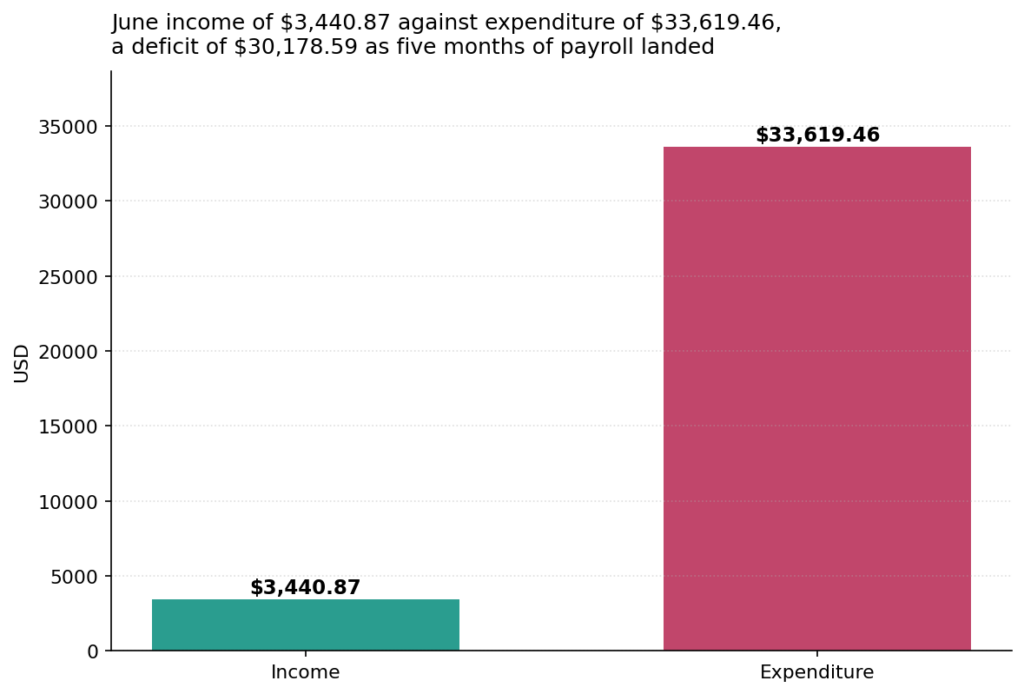
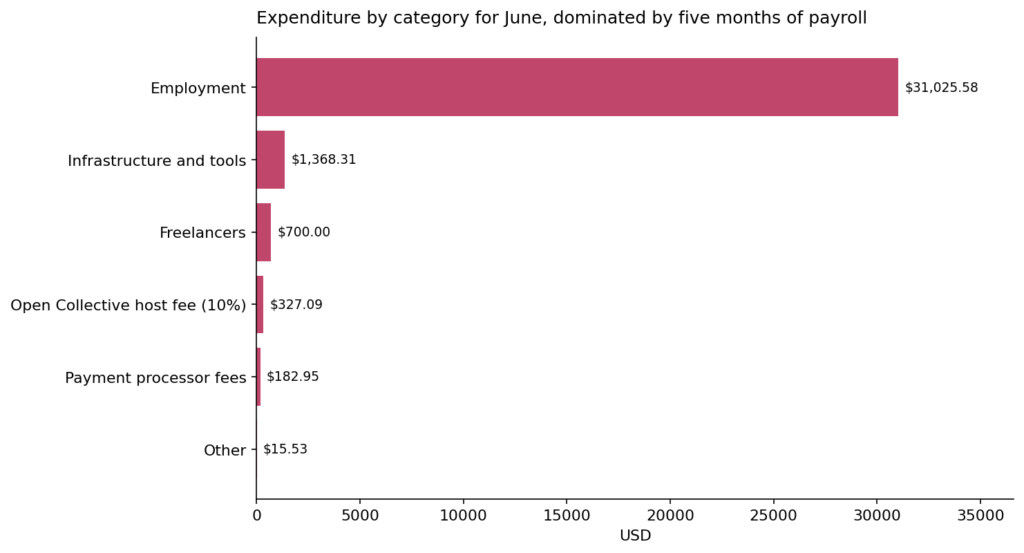
Let me take the deficit apart honestly, because it is not what it first appears. Income for June was $3,440.87 and expenditure was $33,619.46, which leaves a shortfall of $30,178.59. Almost all of that gap is one line, and it is a line I promised you would eventually arrive.
For most of this year our payroll has run on a lag, with each month’s wages paid some weeks or even months later as our income came in. In April and May no payroll was recorded at all, and I said plainly at the time that the cost had been deferred rather than avoided, and would fall in a later month. June is that month. Five separate payroll runs, for February, March, April, May and June, were all settled together in the middle of the month, totalling $31,025.58. So the surpluses that flattered April and May, and the deficit that weighs on June, are two sides of the same timing, and the truer picture is the whole half-year taken together.
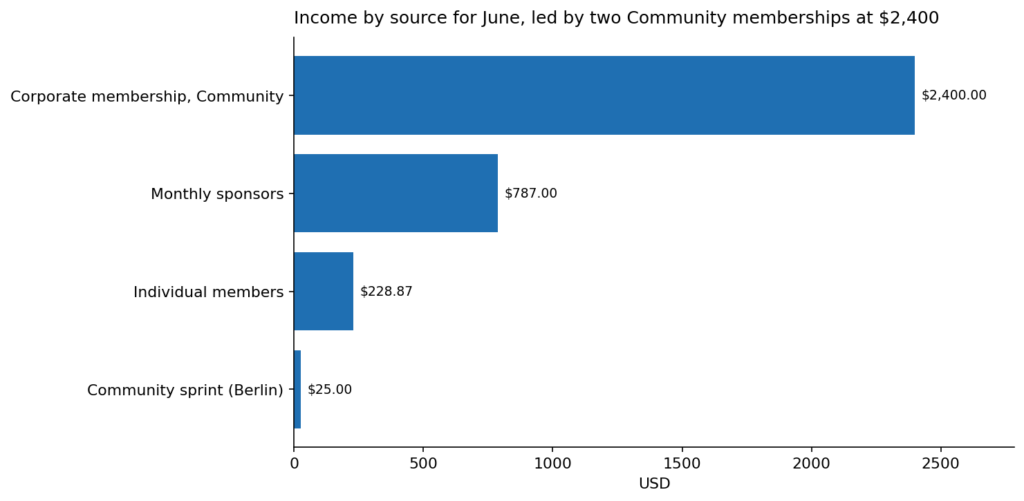
The income itself was modest and steady. We welcomed two renewing Community tier corporate members, Friendly and Higher Education Marketing, and our recurring monthly sponsors continued to give faithfully. There was no fundraiser activity this month, and no revenue share from the Mautic trials, both of which had lifted earlier months, so June leans almost entirely on memberships and regular giving.
Income for June
| Source | Amount |
|---|---|
| Corporate membership, Community | $2,400.00 |
| Monthly sponsors | $787.00 |
| Individual members | $228.87 |
| Community sprint (Berlin) | $25.00 |
| Total | $3,440.87 |
Corporate membership is two Community tier memberships, from Friendly, given through Open Collective, and Higher Education Marketing, through Stripe. Monthly sponsors combines our recurring Open Collective sponsors, among them Aivie, Dropsolid, Sales Snap, Zyxware, Hostnet and e-tailors Europe, with a few small individual monthly gifts. Individual members are two individual memberships taken through Stripe. The community sprint line is a single registration to join us in Berlin.
On the spending side, employment aside, the month was light and ordinary. As with the earlier reports, I have shown every fee in full.
Expenditure for June
| Category | Amount |
|---|---|
| Employment | $31,025.58 |
| Infrastructure and tools | $1,368.31 |
| Freelancers | $700.00 |
| Open Collective host fee (10%) | $327.09 |
| Payment processor fees | $182.95 |
| Other | $15.53 |
| Total | $33,619.46 |
Employment is the five months of payroll described above. Infrastructure and tools is higher than usual this month because it includes an annual subscription to our social media scheduling tool at $1,072.80, alongside our regular hosting and software costs. We are in the process of considering whether, in the future, we might host our own tool using an open source option, but for now we don’t have the resources (people or time) to make this happen so we’re continuing with HeyOrca. The payment processor fees roll up Stripe at $73.89 and Open Collective’s own processors at $109.06, with GiveWP nil this month as there was no income via the fundraiser. Other is a small contributor data stipend and some minor bank card fees.
The full cost of collecting our income this month came to $510.04 in fees, most of it the Open Collective host fee. With no fundraiser running, the GiveWP platform fee that I usually flag as the avoidable one was nil this month.
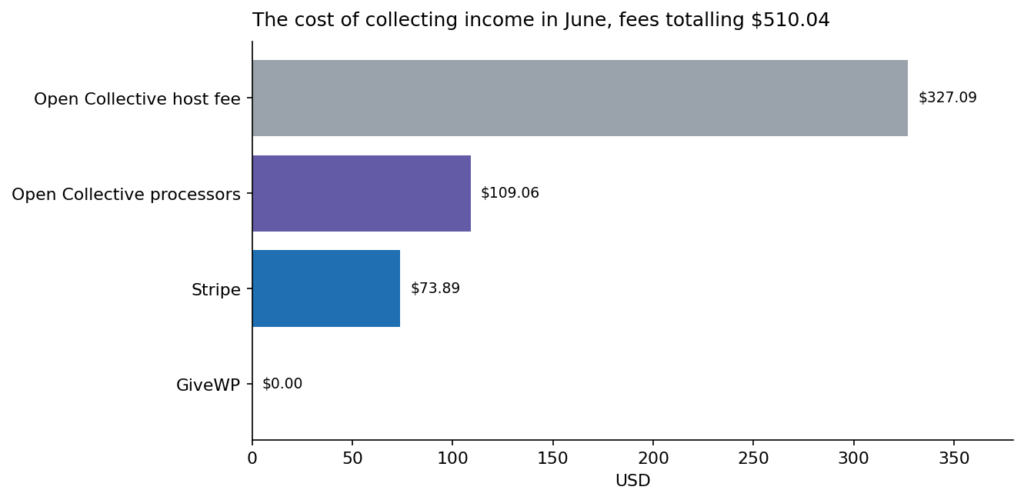
What I take from June’s finances is the value of looking more broadly, at more than one month at a time. A deficit driven by deferred wages is not overspending, it is a bill being paid, and read alongside April and May the project’s position is a bit more steady than it might appear.
We are still in quite a tenuous position, however, due to the small projected incomes over the coming months. Now I’m back at my desk this will be a key area of focus going forward.
Contributions
This was an encouraging month for our contributor community. We welcomed 45 new community members, up 9.76%, and 15 new contributors, unchanged from May, while active members rose by 29.19%. As always, it is worth saying that contributions to Mautic take many forms beyond code, from documentation, translation and design to triage, review, support and helping run our events, and all of it counts here.
The standout of the month was the sheer volume of work our organisations contributed, and a new name at the heart of it.
Tomas Votruba, who created the Rector tool for modernising PHP code, has been volunteering his time to help us reduce our technical debt, and his work appears in the rankings under his own name and as rectorphp. It is exactly the kind of cross-project generosity that keeps open source healthy, and we are grateful for it.
Most active organisations
| Organisation | Activity | Change |
|---|---|---|
| Dropsolid | 334 | ↑ 943.75% |
| Acquia | 268 | ↑ 28.85% |
| Leuchtfeuer Digital Marketing | 181 | ↑ 47.15% |
| rectorphp | 174 | new entry |
| Aivie | 43 | ↑ 258.33% |
| UpScale | 35 | ↑ 133.33% |
| Moorwald, Sven Döring | 26 | ↑ 420% |
| Friendly | 6 | new entry |
| Twentyzen | 5 | new entry |
| Intellect IT | 5 | new entry |
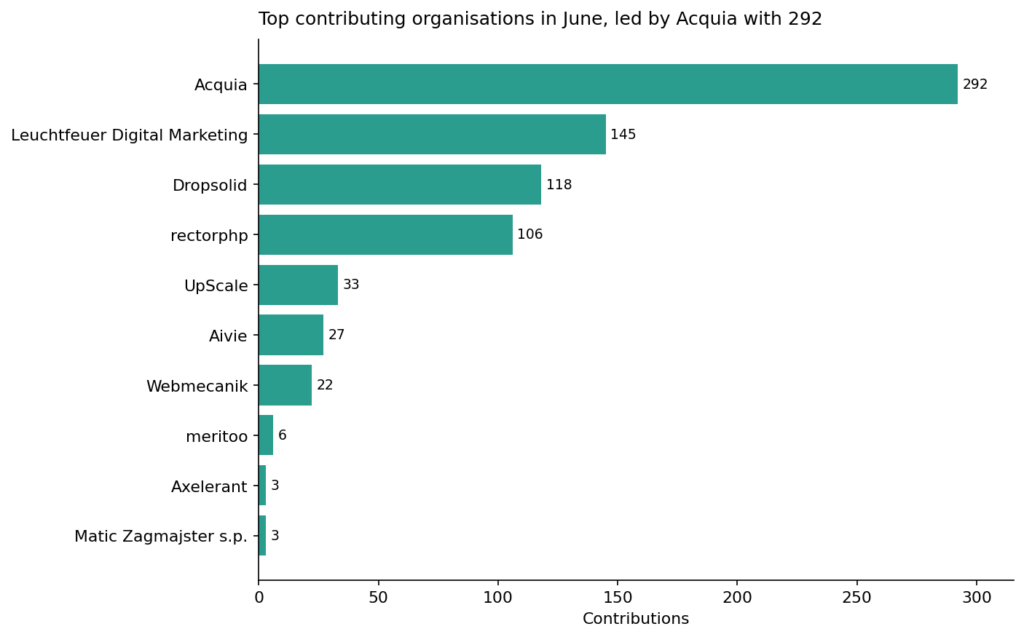
Top contributing organisations
| Organisation | Contributions | Change |
|---|---|---|
| Acquia | 292 | ↑ 94.67% |
| Leuchtfeuer Digital Marketing | 145 | ↑ 95.95% |
| Dropsolid | 118 | ↑ 195% |
| rectorphp | 106 | new entry |
| UpScale | 33 | ↑ 65% |
| Aivie | 27 | ↑ 80% |
| Webmecanik | 22 | ↑ 1000% |
| meritoo | 6 | new entry |
| Axelerant | 3 | new entry |
| Matic Zagmajster s.p. | 3 | new entry |
Dropsolid’s leap in activity – up more than 900% – and Acquia and Leuchtfeuer both lifting their contributions very substantially by over 90% made this a busy month across the board, and it is good to see newer names such as meritoo and Axelerant appearing alongside them.
Most active individual contributors
| Contributor | Activity |
|---|---|
| Anderson José Eccel | 334 |
| John Linhart | 231 |
| Ayu Adiati | 211 |
| Tomas Votruba | 174 |
| Barsha Devi | 62 |
| Ekke Guembel | 62 |
| Margareth Egbuchulam | 42 |
| Patryk Gruszka | 42 |
| Martin Vooremäe | 35 |
| TechEnthusGH | 26 |
Top individual contributors
| Contributor | Contributions |
|---|---|
| Ayu Adiati | 271 |
| John Linhart | 243 |
| Anderson José Eccel | 118 |
| Tomas Votruba | 106 |
| Patryk Gruszka | 59 |
| Lukáš Drahý | 53 |
| Miroslav Fedeleš | 35 |
| Martin Vooremäe | 33 |
| Predrag Vukovic | 27 |
| Zdeno Kuzmany | 22 |
As always, I have kept these rankings focused on our human community, setting aside automated accounts and staff activity.
Usage of Mautic
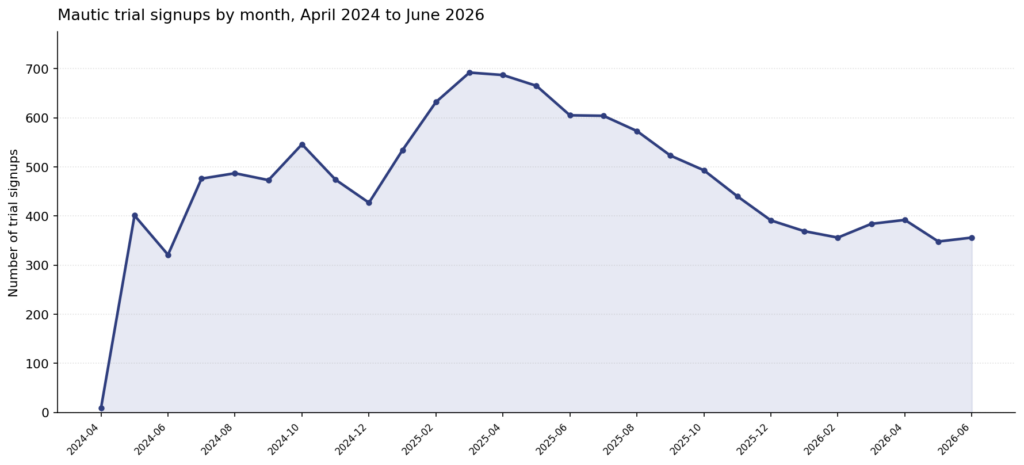
Interest in trying Mautic held steady, with 356 trial signups in June against 348 in May. India led again by a clear margin, followed by the United States and Brazil, with France, Pakistan, the United Kingdom, Morocco, Germany, China and Colombia all featuring.
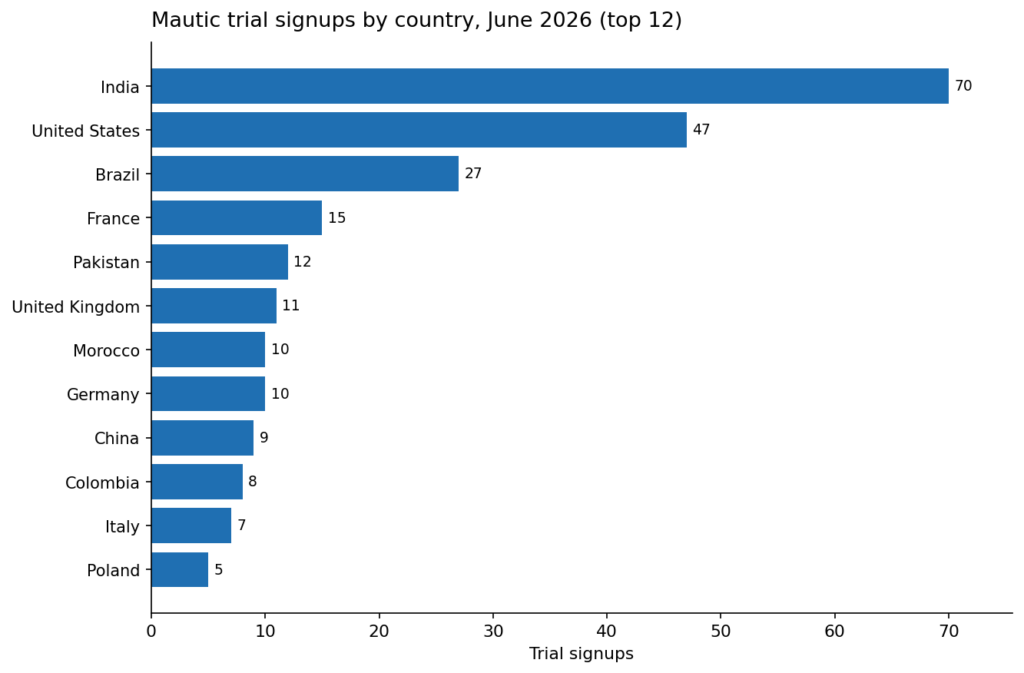
Looking across a longer span, trial signups have settled into a steady rhythm through the first half of 2026, after the higher numbers of early 2025. The month to month picture and its regional shape are worth seeing in full.
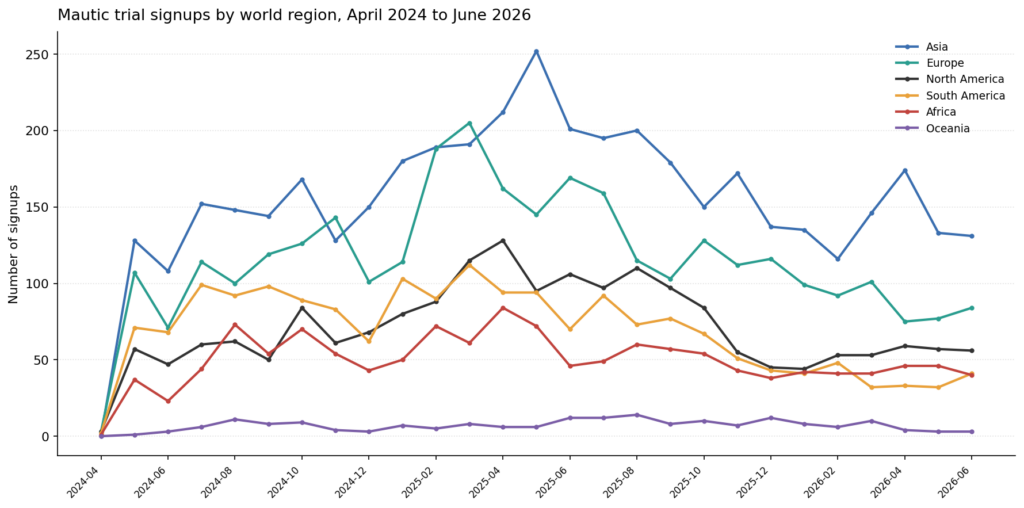
Asia continues to lead the way, followed by Europe, with the Americas and Africa steady behind them. The breadth of countries reaching for an open source path, 189 in this dataset, remains one of the most encouraging signals we have.
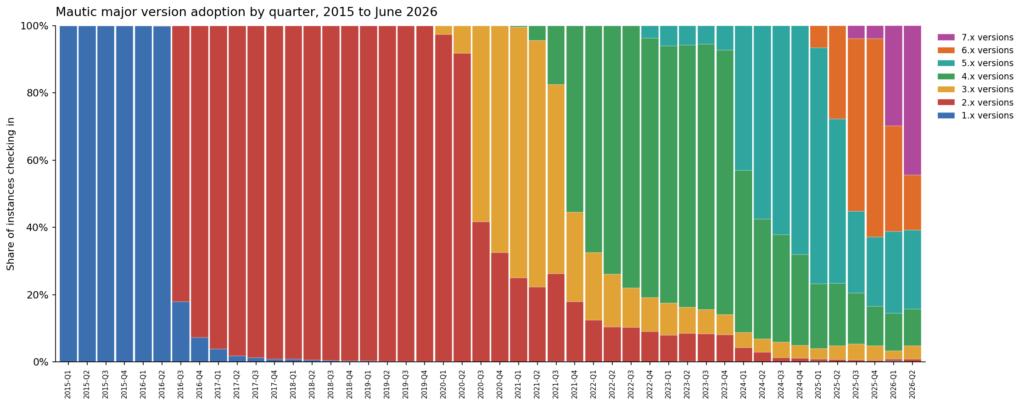
This month I am glad to be able to bring back a view of how Mautic is actually run in the wild, drawn from our updates server, which our instances check in to when they update. I share it with the same honest caveat as always. It can only see instances that check in and have not disabled the update check, so it undercounts the true population and lags behind reality, and it is best read as a broad signal rather than a precise census.
On version adoption, the picture is a healthy one. Mautic 7, released in January, has become the single most common major version among instances checking in during the most recent quarter, at around 44%, ahead of Mautic 5 at roughly 24% and Mautic 6 at 16%. Seeing the newest release move into the lead this quickly is a good sign that our community keeps its installations current.
On how Mautic is installed, the zip-based installer remains overwhelmingly the most common route, at around 88% of the check-ins that report a method, followed by Docker at about 6%, then DDEV and Softaculous. The mix has been remarkably stable over the past two years.
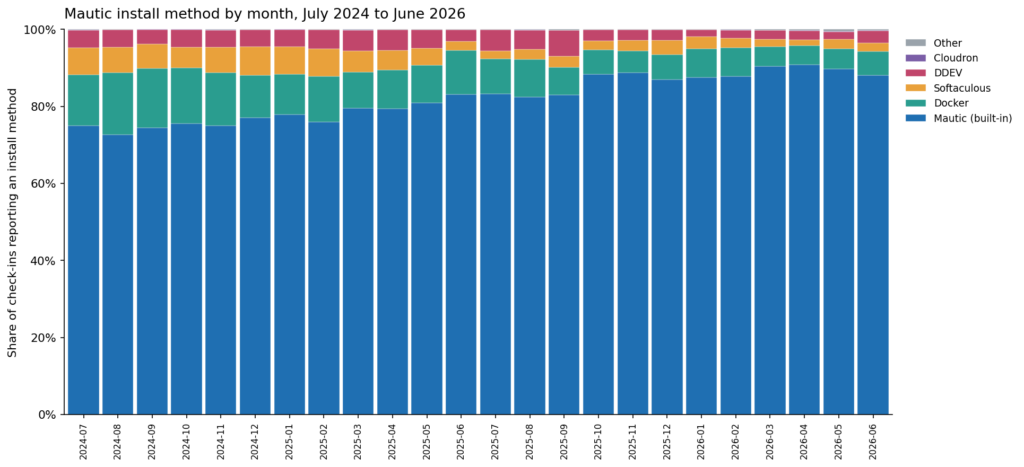
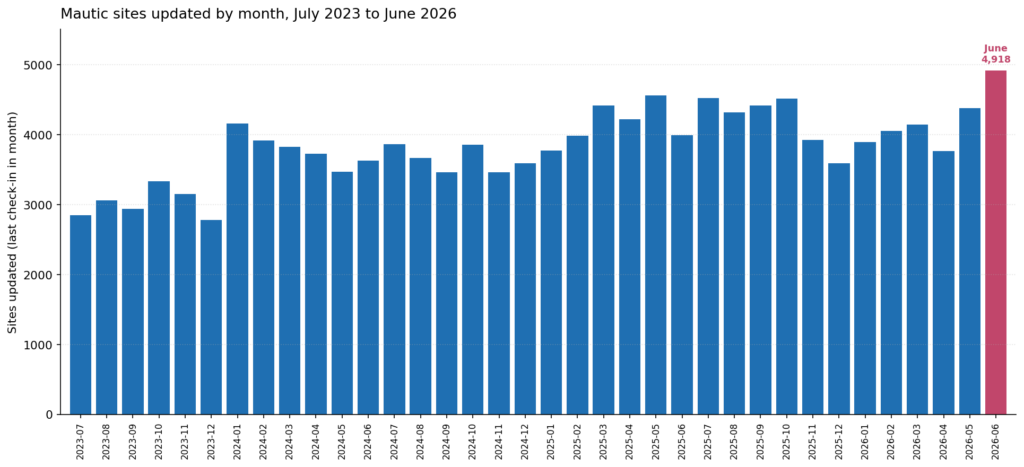
We’re seeing around 5,000 Mautic instances updating each month, according to our updates server – note that not all instances will call back to our updates server (for example corporate SaaS Mautic instances will call back to the company’s server, rather than Mautic’s, and those behind firewalls may not call back at all), and also that this chart shows when the instance last called back (when it last updated) – meaning some of these instances may no longer be in use.
On the underlying platform, the great majority of instances now run PHP 8, with 8.3 the most common single version, though a meaningful tail still runs 7.4 and older, and almost every instance runs on Linux. That tail on older PHP is part of why Tomas’s modernisation work is so welcome.
Community health
The clearest sign of health this month is the depth of contribution, with our leading organisations all lifting their work sharply thanks in no small measure to the sprint we held in Germany, and a fellow maintainer joining us to help modernise the codebase. New members rose, active members rose strongly, and the routes into our community look open and working.
Beyond our own figures, the project’s standing on GitHub remains solid, with the mautic/mautic repository at just over 9,700 stars and over 3,300 forks. Numbers like those are only ever a rough proxy for health, but taken together with a busy month of real contribution they tell a consistent story of a project people continue to build on and build with.
I also want to call attention to the excellent work our Education Team are doing to support contributors who make new code contributions with an automated update to the documentation repositories. This is using a tool called Promptless, which has given us a lifetime free account for Mautic. We’re still working on refining the setup, but so far it’s making really great contributions and dramatically reducing the workload for our developers. Now instead of having to create a documentation PR for the user and developer documentation, they just have to review the proposed PR (which is created using AI and various rules we’ve set up to guide it in writing ‘the Mautic way’) and fix any inaccuracies. Thanks to Promptless for working with us and helping to refine our automated setup, and to Ayu Adiati, Education Team Lead, for taking the lead on this integration.
Conclusion
June asked me to hold two things at once, a frightening number and a healthy reality. The deficit is real on the page, but it is the expected cost paid a little late, and set against April and May it simply squares the books. Underneath it, our community had one of its most productive months of the year. I’ve heard great things about the sprint in Berlin and seen the growth in activity as a result – thanks to everyone who attended!
If you would like to help us build the steady base of income that makes months like this easier to carry, becoming a project member is the most direct way, and as always I would love to hear what this report brings up for you – please comment via the companion post on the forums.
References
Open Source Collective Mautic collective transactions ledger, June 2026. Available at: https://opencollective.com/mautic
Savannah CRM Mautic monthly community report, June 2026. Available at: https://savannahcrm.com/public/report/3f47745a-b6ec-4d0f-94f3-90fa263ed5b6/
Stripe Mautic payment records and balance report, June 2026. Internal account data.
Mautic Trial signup submissions, April 2024 to June 2026. Internal form data.
Mautic Updates server check-in data, 2015 to June 2026. Internal instance telemetry.
OSS Insight mautic/mautic repository analysis. Available at: https://ossinsight.io/analyze/mautic/mautic