A developer just merged a big feature into an app repo, and ‘update the docs’ lands somewhere on their to-do list. Week after week, it keeps sliding down, until it’s forgotten.
If you’ve worked on an open source project, this probably sounds familiar. It’s exactly what was happening to Mautic’s docs, until we found a way to keep docs up to date automatically.
Why docs kept falling behind
Mautic is built by volunteers. Developers who open pull requests – also known as PRs – at mautic/mautic are also juggling day jobs and other feature work. Writing docs updates is important, but it rarely felt urgent, so it kept getting pushed aside. It wasn’t anyone’s fault. It’s just what happens when docs depend on people who are already stretched thin.
As a result, our user documentation and developer documentation fell behind, not by days, but by entire release versions. Users, old and new, ran into outdated instructions or asked questions the code could already answer, but the docs just hadn’t caught up yet.
Discovering Promptless
We learned about Promptless, an AI tool built to write and update docs, through the WriteTech Hub community. We’re grateful for that introduction because it changed how we handle docs entirely.
Promptless connects directly to our documentation repositories, both the user and developer docs, across the several active branches each one maintains for different Mautic versions. That mattered a lot. Mautic doesn’t have just one docs branch to keep current; it has several, one per supported version. Keeping them all in sync by hand was its own challenge.
The workflow that keeps docs up to date automatically
When a developer opens a PR on mautic/mautic, Promptless writes a docs update reflecting the changes.
If the code PR isn’t merged yet, Promptless opens the docs PR as a draft. Once the code PR is merged, it automatically marks the docs PR as ready for review. If the developer adds more changes – for example, as a result of the code review process – Promptless updates the docs draft to match.
We didn’t jump straight into full automation, though. We started by having Promptless watch code PRs and post suggestions on its dashboard. The Education Team then reviewed each one before turning it into an actual PR. Once we saw how consistently Promptless followed our style guide and aligned with the intent of the code changes, we felt confident in opting into the fully automated workflow. That trial period built trust in the tool before we handed over more of the process.
Developers still play a part. They no longer update the docs themselves, but they do review Promptless’s draft and confirm it matches what they built. The Education Team then reviews grammar, wording, and style the same way we would for any docs contribution.
Since Promptless joined, the numbers tell a clear story. In about four months, 129 of Promptless’s docs PRs were merged. Over more than four years, 392 PRs from human contributors were merged.
Turnaround time backs this up. Looking at a sample of merged PRs, docs updates made by Promptless took an average of 27 days from code merge to docs merge. Docs written by hand averaged 98 days. That’s roughly 3.5 times faster.
The clearest sign of progress is the release gap itself. At one point, the app had already moved to version 7.0 while the docs were stuck at 5.2, two versions behind. Docs started catching up around 7.1. By 7.2, they were moving fast, right when the automated Promptless workflow began.
Why human review still matters
Promptless – like any AI tool – doesn’t always get it right, and that’s exactly why a human still checks every draft before it goes live.
Every Promptless suggestion goes through the same process as any other contribution before it’s merged. That step catches real issues.
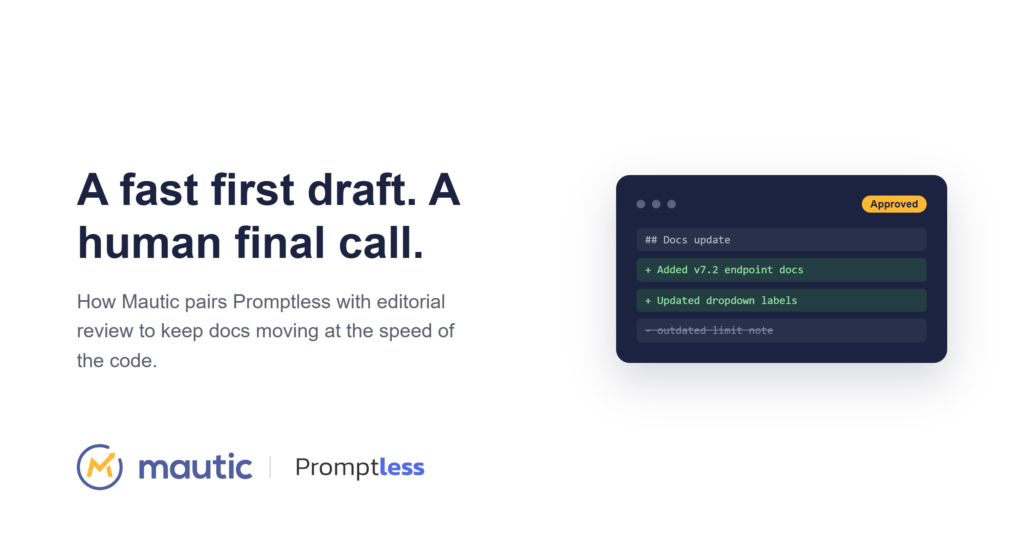
Take one example. Promptless once drafted a new section for an updated dropdown menu, but the improved labels already made the feature self-explanatory, so the section would have only duplicated existing content. The code PR’s author caught it during review, and Promptless withdrew the PR.
Another time, a draft described a button that no longer exists and a limit that had already been removed from the code. Again, it was the code PR’s author who flagged it. Promptless checked the codebase and fixed the draft, and the Education Team merged it once the correction looked right. Both cases show why it matters to have the developer who made the code change review the docs update too, not just the Education Team.
Style and wording issues also come up. Formatting, generic wording, and specific Mautic feature or UI terms sometimes need a few rounds of feedback from the Education Team before a PR is ready to merge.
The good news is that these issues fade over time. Promptless has also gotten progressively more accurate – partly because we train it directly on what to remember, and partly because it picks up on patterns from our corrections. That’s made review lighter over time, but not something we skip. Nothing beats a human check before docs go live, and that’s exactly how we use Promptless: a fast first draft, with a person making the final call.
Working with a supportive team
The tool is only half of it. The people behind it make the difference.
Prithvi Ramakrishnan and the rest of the Promptless team have been responsive from day one, even with the time difference between our EU-based Education Team and their US hours. Most questions get an answer within hours, or by their next morning at the latest.
When something doesn’t fit Mautic’s setup, they don’t ask us to change how we work. They jump on a call, dig in with us, and adjust Promptless to match our workflow instead. Fixes usually ship within days, sometimes a week. If it needs more time, they tell us upfront. Several of the things we’ve bumped up against have been improvements they’ve shipped in their core product, not just workarounds they make for us.
That kind of support made it easy to hand something as important as our docs over to an AI tool. Promptless has become a valued part of how we maintain our docs, and it’s had a genuinely positive effect on our whole community.
Final words
Docs are the frontline of any product. Users, and increasingly AI agents, can’t discover, use, or get the most out of great features if the docs are missing or out of date. Yet it’s often the first thing to fall behind, and the last thing to get attention.
Promptless helped us catch up without asking already-busy developers to do more.
If your organization struggles to keep docs up to date, especially with a large codebase or multiple versions to maintain, Promptless is worth checking out.